After-Sales:
 EN
EN
 AR
AR
 HR
HR
 NL
NL
 FI
FI
 FR
FR
 DE
DE
 EL
EL
 HI
HI
 IT
IT
 PT
PT
 RO
RO
 RU
RU
 ES
ES
 TL
TL
 ID
ID
 SL
SL
 VI
VI
 ET
ET
 MT
MT
 TH
TH
 FA
FA
 AF
AF
 MS
MS
 IS
IS
 MK
MK
 HY
HY
 AZ
AZ
 KA
KA
 UR
UR
 BN
BN
 BS
BS
 KM
KM
 LO
LO
 LA
LA
 MN
MN
 NE
NE
 MY
MY
 UZ
UZ
 KU
KU


News
5 Types of Commercial Ovens for Bakeries: Features and Buying Tips
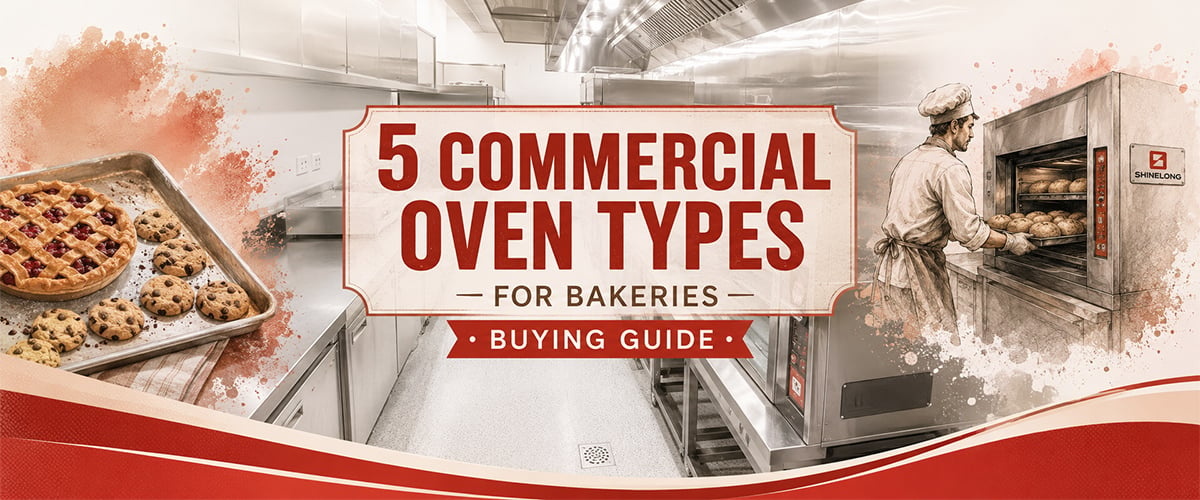
If you're thinking about building a bakery or a commercial kitchen with a pastry corner, chances are you're already stuck on one question: which type of commercial oven should I choose?
Before you start anything, make sure you figure out these 3 questions:
- What are you going to bake?
- How many items do you produce per day?
- How much floor space do you have?
In this guide, SHINELONG experts break down the five most common commercial oven types for bakeries, compare their key features side by side, and walk through the buying factors, such as power source, energy use, and every other detail that actually matters when you're making the decision. By the end, you'll know which oven type and which SHINELONG model fits your bakery.
Commercial Oven Types Compared: Quick Overview
| Oven Type | Best for | Heat Style | Example Model |
| Convection Oven | Cakes, cookies, muffins, viennoiserie, small pastries | Forced hot air via fans, gas or electric | Max Series Gas Convection Oven |
| Combi Oven | Mixed bakery-plus-kitchen output, delicate pastry, reheating | Convection + injected steam, programmable | 10 Tray Combi Oven |
| Deck Oven | Artisan bread, baguettes, pizza, hearth-baked items | Radiant stone-deck heat, top and bottom elements | Deck Oven with Proofer |
| Rotary Oven | High-volume bread, rolls, batch production | Circulating hot air with rotating rack | 16-Tray Electric Rotary Convection Oven |
| Conveyor Oven | Pizza bases, flatbreads, mass-produced cookies | Continuous belt, fixed heat zones | / |
5 Types of Commercial Ovens for Bakeries, Explained
A functional and appropriate commercial oven that matches the menu and kitchen types determines the efficiency of daily workflow and business success. There're 5 essential types of commercial ovens for bakery use.
Convection Oven
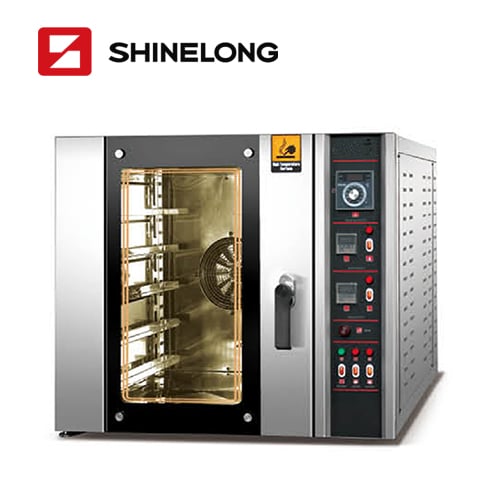
Designed with an internal fan, the convection oven is able to create an even baking environment by offering circulated heated air across the entire cabinet, which allows chefs to produce baked goods way faster than a traditional oven, typically 20-25% faster.
That circulating air is a gift for cakes, cookies and pastries, and a problem for anything that needs a slow, still bake. Delicate soufflés and very thin batters can collapse or deflate under constant airflow.
You can choose an electric or gas model depending on your bakery setup. Gas models recover heat quickly after the door opens, while electric models offer more precise, stable temperature control.
- Even Heat Distribution: Independent fan creates circulated heat flow to maintain an even cooking environment.
- Shorter Bake Time: Moving air speeds up heat transfer into the food and reduces bake time by 20-25%.
- Perfect Performance: Stable temperature range and even distributed heat make sure every product is perfect.
Combi Oven
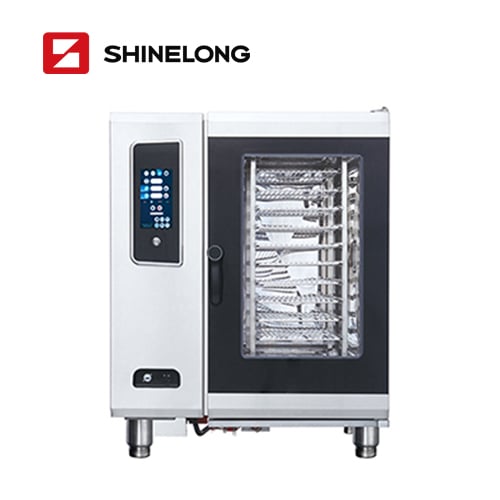
Running two heat sources in one cavity, a combi oven delivers three cooking methods: convection, steam, and a combination mode where humidity is dialed in independently, usually in 10% steps from 0 to 100%.
Steam mode cooks gently with moist heat, convection browns and crisps, and combination mode controls crust and internal moisture at the same time. That humidity control earns its keep on anything sensitive to moisture.
A combi oven needs to run on a connected water supply to generate steam, and sit under a ventilation hood to clear the output and both belong in the installation budget from day one.
- Consistent Performance: Features programmable controls to store hundreds of recipes, ensuring consistent food quality and taste at scale.
- Space Saving: One cavity replaces a steamer, a convection oven, and a holding cabinet
- Better Moisture Retention: Steam-assisted baking keeps interiors moist while the exterior still browns and crisps.
Deck Oven
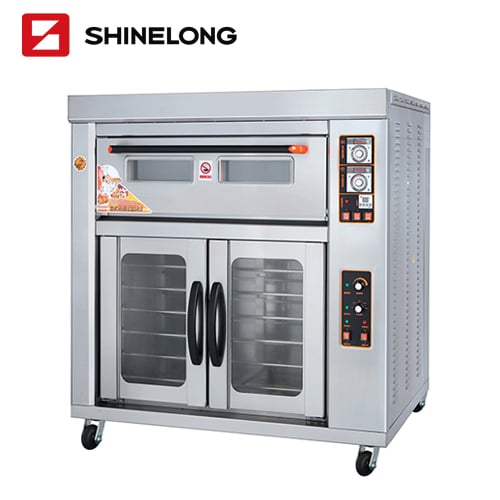
As one of the most common oven types in every bakery, a deck oven cooks by direct contact. Heat conducts up through the deck into the base of the dough, while radiant heat from above finishes the top.
There are various models available, ranging from countertop to multi-deck to combination setups. For most bakeries, multiple decks dominate the line, each with independent temperature control, allowing bakers to cook different products in separate chambers.
If you're running a tight kitchen, a combination deck oven is the way to go: a stackable deck on top, a multi-rack proofer on the base, which means you can proof and bake in one unit, saving you more space.
- Direct Crust Development: Conducted heat from the deck surface builds a thicker, more developed crust than convection or rotary baking can produce.
- Independent Deck Control: Each deck runs its own temperature, so different products can bake side by side without compromise.
- Maximized Productivity: Operating multiple stacked decks multiplies daily baking output without expanding your kitchen footprint.
Rotary Oven
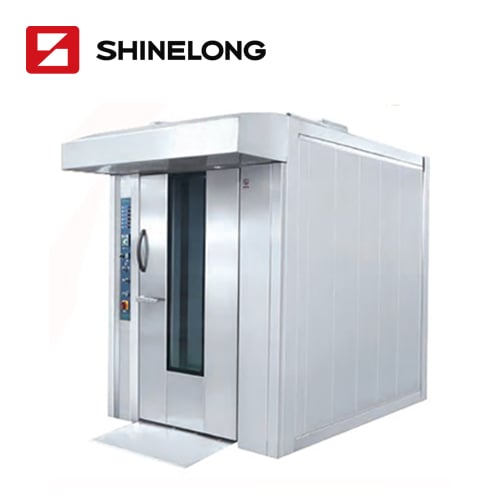
A rotary oven is a professional baking appliance, built to load an entire bakery trolley at once, not just one or two trays like a deck oven or convection oven. An internal rotating rack keeps every item exposed to the same heat as it turns, an approach built for consistency at scale.
Rotary ovens come in gas, electric, and diesel versions, and trolley capacity is the main spec to weigh: more trays per trolley means fewer loading cycles per day, but also a larger machine footprint and higher upfront cost.
For more information about commercial rotary ovens, check out the Rotary Oven Guide.
- Uniform Browning: Constant rotation exposes every tray to the same heat, eliminating the position-based hot and cold spots common in static ovens.
- High-Capacity Loading: A single trolley carries dozens of trays, cutting the number of load-and-unload cycles needed per shift.
- Consistent Output at Scale: Once loaded, output per bake cycle stays predictable, which makes daily production planning easier for wholesale and high-volume orders.
Conveyor Oven
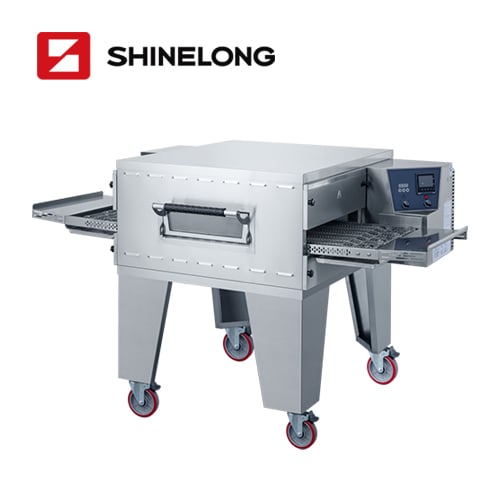
A conveyor oven moves product through the baking chamber on a continuously running belt instead of holding it on fixed racks or decks. Product goes in one end, passes through a set heat zone at a fixed speed, and comes out done at the other end; no door to open, no manual timing to track.
Belt width and speed are the two specs that matter most here. A wider belt moves more product per hour, and adjustable speed lets the same oven handle slightly different bake times without retooling the line. Most models run gas or electric, with gas favored for high-throughput lines where recovery speed matters.
This setup works best for a single product baked the same way, over and over: pizza bases, flatbread, mass-produced cookies. Once belt speed and heat zones are dialed in, the oven runs identically every time, which is exactly the point for a high-volume, low-variation menu.
- Predictable Output: Fixed belt speed and heat zones keep bake times and quality consistent from the first unit to the last.
- Lower Operator Dependency: Once set, the oven needs minimal manual adjustment, reducing reliance on a skilled operator watching every bake.
- Continuous Production Flow: Product moves through baking without stopping the line, suited to high-volume, single-product operations.
How to Choose the Right Commercial Oven for Your Bakery
When it comes to choosing the right baking appliance for your bakery, it's not enough to just glance at features and specifications. Very few people, especially first-time bakery owners or pastry managers, actually know how everything comes together. That's what we're here to help with. SHINELONG experts have listed out the essential things to consider before making a decision, since each one affects whether your daily workflow stays on track.
1. Match the Oven to Your Product Range
Knowing what you're going to bake matters more than any spec sheet. Don't get fixated on the numbers alone. Bread and pizza want direct deck heat for crust. Cakes, cookies and pastries want circulated convection air for an even bake across every rack. Anything humidity-sensitive wants a combi oven's steam control. A bakery running a genuinely mixed menu often ends up with two oven types working together instead of one oven trying to do everything.
2. Estimate Your Daily Output and Tray Capacity
Once what you bake narrows down the oven type, daily output decides how many trays you actually need and how to configure the line. A small bakery baking a few hundred units a day can run comfortably on a countertop or double-deck oven. Cross into wholesale or supermarket-supply territory, and tray count per cycle becomes the number that decides everything else. That's where rotary ovens take over, because a single trolley load replaces multiple deck-oven cycles.
3. Gas or Electric: Which Fits Your Kitchen?
Gas ovens recover heat faster once the door opens, which helps on a busy line that's loading and unloading all day. Electric ovens hold a steadier, more precise temperature, better suited to delicate bakes where a few degrees can change the result. The decision usually comes down to what's already run into the building. Installing a new gas line costs more than most bakeries expect, so check utility access before settling on a specific model.
4. Space, Ventilation and Installation Requirements
Every oven needs clearance on all sides for heat dissipation and door swing. Gas models also need a flue or extraction hood to vent combustion byproducts, and combi ovens add a water line on top of that. Before ordering, measure the delivery path as well. A rotary oven trolley often needs a wider doorway than most kitchens assume.
5. Steam Injection and Humidity Control
Not every bakery needs it, but for bread with a real crust, steam at the start of the bake is what produces the oven spring before the crust sets. Deck ovens often offer it as an add-on, while combi ovens build it in as a core function. If the product range doesn't touch bread or laminated pastry, this feature can usually be skipped without losing quality.
6. Preheat Time and Temperature Accuracy
Deck ovens, with their dense stone or metal decks, take longer to preheat than convection ovens, but they hold heat more evenly once they get there. Digital, programmable controls tend to hold temperature more tightly than older mechanical dials. This is worth checking on any oven where a few degrees of drift would show up in the final bake.
7. Energy Efficiency and Running Costs
Insulation quality and door seal condition affect running costs more than fuel type does. A well-insulated oven with a tight seal holds heat between loads instead of constantly reheating, and that's where real energy savings show up over a year of daily use, not just on the efficiency rating sticker.
8. Budget and Total Cost of Ownership
The purchase price is only the starting number. Installation, any gas or water line work, and a ventilation hood can add a meaningful amount before the oven bakes anything. A used oven can lower the upfront cost, but factor in the age of the heating elements or burners, and how easily replacement parts are still available.
9. Maintenance, Cleaning and After-Sales Support
Daily wipe-downs and a scheduled deep clean keep any oven running at spec, but the bigger factor is parts and support access after the sale. Confirm what's covered under warranty, and how quickly a supplier can get a replacement part to your kitchen if something fails mid-week.
10. Certification and Compliance
Commercial kitchen equipment needs to meet the electrical and gas safety standards for wherever it's installed. That means CE marking in the EU, UKCA in the UK, and equivalent certifications elsewhere. Confirm this before ordering, not after delivery. Retrofitting a non-compliant oven to pass inspection costs far more than buying compliant from the start.
Which Oven Fits Your Bakery Type? Start with Your Daily Baking Output
| Daily Baking Output | Bakery Type | Ideal Oven Type | Tray Capacity per Load |
| Under 200 baked goods/day | Café corner, home-to-shop start-up, dessert counter | Countertop convection or single-deck oven | 2–4 trays |
| 100–300 cakes, or 300–600 pastries per day | Small retail bakery, patisserie, hotel pastry corner | 6-rack convection oven or Combi oven | 6 trays |
| 150–400 loaves, or 400–800 mixed items per day | Bakehouse or artisan shop | Multiple deck oven (add convection as secondary) | 6 trays across 3 independent decks |
| 400–1,000 loaves, or 800–1,500 mixed items per day | Established artisan bakery, pizza-and-bread operation | Combination deck oven with proofer or 2*20 tray combi oven | 16 trays across 4 decks |
| 1,000–2,500 breads per day | High-volume retail, small wholesale, hotel central bakery | Single rotary/rack oven (16–18 trays per rack) | 1 full rack, 16–18 trays |
| 2,500+ bakery Items per day | Industrial bakery, wholesale supplier, central kitchen | Multiple rotary ovens, or rotary + combi line | 2+ racks running in parallel |
*Output ranges are general guidance. Actual tray needs vary by product size and bake time.
1. Small or Start-Up Bakery
Floor space and budget are tight, and daily output is still building. A countertop or double-deck oven covers most early-stage menus without committing to a full production footprint, giving enough capacity to prove out the business before scaling up. For more information about designing a small bakery kitchen, check the small bakery kitchen design guide.
2. Artisan or Craft Bakery
Crust and crumb quality are the whole point, so a deck oven with steam injection is the standard choice. A combi oven fills the gap for laminated pastry and brioche work that a straight deck oven doesn't handle as well.
3. High-Volume or Industrial Bakery
Output numbers drive every decision here. A rotary oven, sized to trolley capacity and daily bake cycles, keeps a wholesale or supermarket-supply line running at consistent volume, often paired with a conveyor oven for single-product runs like flatbread or pizza bases.
FAQs
1. Can you recommend the best commercial ovens for baking large quantities of bread?
Honestly, once you're past a few hundred loaves a day, a deck oven alone starts to bottleneck you no matter how many decks you stack. That's when a rotary oven earns its keep, you load a full trolley at once instead of tray by tray, and the rotating rack keeps every loaf exposed to the same heat so you're not pulling half a rack early. If you're running 1,000+ loaves a day, SHINELONG's 32-Tray Electric Rotary Convection Oven is built for exactly that volume. Past 2,500 a day, most bakeries stop looking at a single oven and start running multiple rotaries in parallel instead.
2. What should I consider when choosing a commercial oven for baking cakes?
Cakes want even, circulated heat, not direct contact heat like bread does. That's a convection oven's whole job: the fan keeps hot air moving so every rack browns at the same rate, no more one tray done and the next one still pale. If you're doing under 300 cakes a day, a 6-rack convection oven covers it comfortably. If you're also baking anything moisture-sensitive alongside the cakes, like laminated pastry, a combi oven does both jobs in one cavity.
3. What are the best bakery ovens for small bakeries?
For a small setup, don't overbuy. A countertop convection oven or a single/double-deck oven covers most menus under about 200 baked goods a day without eating your whole floor plan or budget. Scale into the oven as your output grows instead of buying for volume you don't have yet. If you're still figuring out the layout itself, our small bakery kitchen design guide walks through floor plans that actually fit an oven, a proofer, and a prep line without feeling cramped.
4. What should I consider when choosing a commercial oven for a bakery?
Three things decide almost everything else: what you're baking, how much you're producing daily, and how much space and utility access (gas line, water line, ventilation) you actually have. Get those three answered first, then worry about gas vs electric, steam injection, and budget. Buying the "best" oven on paper before answering those three questions is how bakeries end up with equipment that doesn't fit their kitchen or their menu.
5. What features should I look for in a bakery oven for baking bread and cakes?
This is the classic mixed-menu problem: bread wants direct deck heat for crust, cakes want circulated convection air for an even crumb. No single oven type does both perfectly. A combi oven is the closest thing to a compromise, since it switches between steam and dry convection heat and lets you dial in humidity independently. But if bread is a serious part of your output, not just a side item, a dedicated deck oven will still outperform a combi on crust every time.
6. What type of commercial oven is best for cakes and pies?
Split them mentally. Cakes want even circulated air, so convection is the default answer. Pies are closer to bread in one way: the bottom crust needs direct, solid heat to crisp up instead of turning soggy, which is the same principle that makes a deck oven's stone or metal surface work so well for bread. If pies are a big part of the menu, a combi oven's convection mode plus a lower deck for bottom heat gives you both jobs without needing two completely separate ovens.
7. How do convection ovens differ from traditional ovens?
A traditional (static) oven just heats the cabinet and lets the air sit still, so heat rises unevenly and whatever's near the top or the back cooks differently than what's on the bottom rack. That's why old-school baking often means rotating trays halfway through. A convection oven adds a fan that keeps the air actively moving, which evens out that temperature gradient and, in most cases, cuts bake time by 20-25% because moving air transfers heat faster than still air.
8. How do I choose between electric and gas bakery ovens?
Check what utilities are already running to the building before anything else. Gas ovens recover heat faster once you open the door, which matters if you're loading and unloading constantly during a rush. Electric ovens hold a steadier, more precise temperature, which matters more for delicate bakes. If there's no gas line already installed, factor that cost in before you fall in love with a specific gas model. It adds up fast.