After-Sales:
 EN
EN
 AR
AR
 HR
HR
 NL
NL
 FI
FI
 FR
FR
 DE
DE
 EL
EL
 HI
HI
 IT
IT
 PT
PT
 RO
RO
 RU
RU
 ES
ES
 TL
TL
 ID
ID
 SL
SL
 VI
VI
 ET
ET
 MT
MT
 TH
TH
 FA
FA
 AF
AF
 MS
MS
 IS
IS
 MK
MK
 HY
HY
 AZ
AZ
 KA
KA
 UR
UR
 BN
BN
 BS
BS
 KM
KM
 LO
LO
 LA
LA
 MN
MN
 NE
NE
 MY
MY
 UZ
UZ
 KU
KU


News
Commercial Kitchen Design: The Ultimate Guide to Foodservice Systems, Layout and Costs
Building a foodservice establishment is never an easy task; you need to build a brand, lock in your foodservice system, and design a commercial kitchen that actually supports how you operate. The real question is: how do you make sure the entire back of house can support throughput without being the bottleneck?
Actually, a well-designed commercial kitchen directly affects how fast food moves from storage to plate, how comfortably staff can work, and how much waste gets quietly decreased. Whether opening a casual restaurant, launching a university cafeteria, or building a fine dining kitchen inside a hotel, commercial kitchen design isn't optional. This guide breaks down the layout options, foodservice system types, workflow logic, and real-world costs so the decisions are made on the right track.
What Is Commercial Kitchen Design
Commercial kitchen design is the structured process of planning a professional foodservice space to support staff, ensuring every process prioritises efficiency, safety, and consistency, which eventually improves guests' dining experience. It covers everything from where the blast chiller sits relative to the prep bench, to how many sinks are needed for regulatory compliance, to which cooking equipment the concept actually requires, to the path a dirty plate travels from table to dishwasher without crossing a clean one.
A thoughtfully designed kitchen does a few key things:
- Reduces unnecessary movement: every extra step a chef takes is wasted time and money
- Supports food safety: logical separation of raw and cooked zones prevents cross-contamination
- Keeps staff comfortable: ergonomic layouts reduce fatigue and injury
- Boosts throughput: the right layout means more covers without more staff
- Driven by the foodservice system: the layout, zones, equipment, and ingredient flow from storage to portioning are all determined by which system the operation runs
The difference between a designed kitchen and one that just "happened" becomes obvious in a rush. Designed kitchens flow. The other kind... doesn't.
Foodservice System Types Explained
Before touching a floor plan, it helps to identify which foodservice system model fits the operation. This single decision shapes almost every design choice that follows. But what exactly is a foodservice system? In short, it's a structured approach to managing the full process from food production to service, determining how ingredients are stored, produced, and delivered to the guest.
There are four main types, defined by how they prepare and serve food. Each one demands a different kitchen.
| Type | How It Works | Key Operational Flow | Best For |
| Conventional | Food is prepared and cooked on-site, served immediately | Production → Immediate Service (Held hot/cold briefly) | Independent Restaurants, Fine Dining, Hotels, Cafeterias |
| Commissary | Food is produced centrally and distributed to remote service points | Mass Production → Storage (Frozen/Chilled) → Distribution to Satellite Kitchens | Large School Districts, Airline Catering, Chain Restaurants (QSRs), Healthcare Systems |
| Ready Prepared | Food is cooked ahead, chilled or frozen, and regenerated for service | Production → Chilled/Frozen Storage → Reheating → Service | Large Hospitals, Prisons, Large-Scale Banqueting |
| Assembly-Serve | Pre-prepared components are assembled and served with minimal cooking | Storage → Portioning → Heating → Service | Convenience Stores, Fast-Food Kiosks, Small Specialty Cafés |
Each system demands a different equipment mix, different storage capacity, and a different spatial logic. For example, a fine dining with a cook-to-serve kitchen, commercial cooking range and combi oven definitely is an essential solution. But for a tiny convenience store, all it needs is just a microwave or a speed oven. Defining the foodservice type upfront avoids expensive mistakes later.
Commercial Kitchen Layout Types Matter
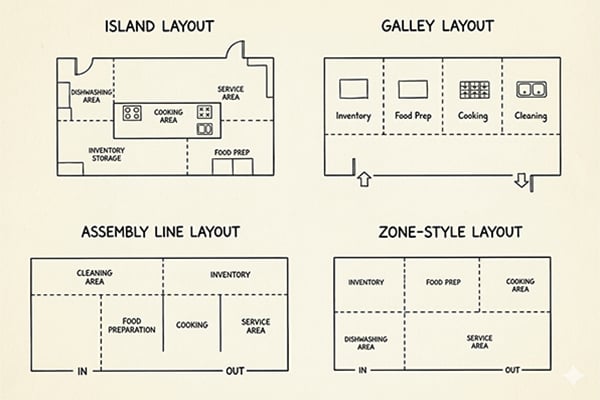
Once the foodservice system is locked in, layout design is the next big step. The four basic commercial kitchen layout types each suit different concepts and spaces.
- Assembly Line Layout
Stations are arranged in a straight line, with food moving sequentially from prep to cook to plate to pass. Fast, efficient, and great for high-volume QSR and fast-casual operations. Undoubtedly, the go-to for fast-food franchises is built around signature combo meals, but the lack of flexibility makes it less suited to complex menus or multi-section kitchens. - Island Layout
Cooking equipment, such as commercial ranges or island suites, is placed in a central island, with prep and storage running around the perimeter. A popular choice for full-service restaurants, it encourages communication between chefs, gives the head chef a clear sightline across the kitchen, and allows flexible workflow. It does require more floor space compared with the last one. - Zone Layout
The kitchen is divided into dedicated zones: pastry, sauté, grill, cold prep, and so on. Each zone operates semi-independently. This is a great solution for multi-cuisine restaurants, cafeterias serving a variety of cuisines, hotel kitchens, and fine dining establishments where different dishes have very different production needs. - Galley Layout
Two parallel runs of equipment face each other across a central aisle. Common in narrow spaces, for instance, food trucks, shipping container kitchens, and compact café kitchens. Efficient use of linear space, but can become seriously congested during peak service.
Before these 4 common kitchen layouts above, the open style kitchen has been the priority in recent years, with the advantage of balancing appetite and engagement while keeping up with high serving efficiency. However, it requires powerful kitchen ventilation to manage noise and odor, as well as strict, consistent cleaning routines to maintain the dining experience.
Designing the Workflow, From Production to Portion
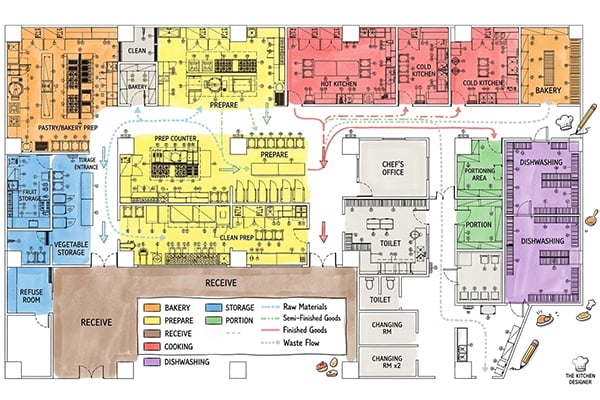
Layout type is only part of the entire design process. The real detail lies in how the kitchen actually works: how food travels from receiving to dispatch, how equipment is positioned to support that journey, and how staff flows through the space without crossing paths. In short, a good commercial kitchen workflow design must account for the foodservice system in use, the placement of zones and stations, and the logical sequence that connects them. Get the flow right and the kitchen runs with quiet efficiency. Get it wrong and the layout fights the team every single service.
| Zone | Function | Key Characteristics |
| Receive | Goods arrive, are weighed and checked | Near loading access, separate from service areas |
| Storage | Dry goods, refrigeration, freezer | Proximity to both receiving and prep; temperature zoning |
| Preparation | Washing, peeling, portioning and etc | Dedicated surfaces for raw meat, fish, and veg |
| Cooking | All hot cooking equipment | Ventilation canopy directly overhead; extraction capacity matched to equipment |
| Hold | Keeping food at safe temperatures | Food is cooked ahead, chilled or warmed in this area, and regenerated for service. It is essential for the operation |
| Serving | Dishes finished and servers pick them up | Needs to be accessible for both kitchen staff and servers |
| Cooling | Vital for food safety in "Ready Prepared" systems | Often features blast chillers. This zone must be separated from the hot line to avoid raising the ambient temperature. |
| Reheated | To "regenerate" food quickly and evenly without losing quality | The key section of the commissary and satellite kitchen models. But in most casual restaurants or limited space operations, they would reheat the food in hotline. |
| Warewashing | Dirty dishes returned and washed | Dirty in, clean out; no cross-over with food zones |
The principle of workflow design is pretty simple: clean food should never share a path with dirty dishes, and raw proteins should never share surfaces with ready-to-eat food.
Choosing the Right Equipment for the Main Areas
Equipment selection is where commercial kitchen design gets personal. Once the location, foodservice system, layout, and expected daily throughput are confirmed, matching the right line of equipment to the operation is the next critical step. It's about matching every piece of appliance to the actual needs, the volume of covers, and the production method the kitchen runs.
1. Commercial Cooking Equipment
The versatile cooking range or island cooking suite is always the perfect solution for any commercial kitchen. Take SHINELONG 700/900 series as an example, it allows a hot line to be configured from various cooktop options: gas burners, induction zones, griddles, and fryers matched precisely to the menu. Two base options are available, oven base and cabinet base, giving chefs more flexibility to handle complex cooking tasks without taking up extra space.
For versatility and batch cooking, the combi oven is often the smartest investment. One unit handles steam, convection, and combination modes, roast, bake, steam vegetables, and regenerate chilled meals, all from a single unit. RATIONAL, Unox, and SHINELONG all have solid models worth comparing, depending on budget and local service support.
Click here to learn the definition of commercial cooking ranges
Click here to learn the definition of the island cooking suite
2. Refrigeration
Walk-in cold rooms and freezers, from brands like Furnotel and Williams, form the backbone of storage. Blast chillers are essential for kitchens running a ready-prepared foodservice system or operating satellite kitchens. Meanwhile, undercounter refrigerated prep tables are critical in small restaurants and some light cooking kitchens, such as pizza, salad, and sandwich concepts, especially combining cold storage and workspace in a single unit.
3. Dishwashing
A hood-type pass-through dishwasher handles most mid-volume restaurants. For hospitals, universities, and large institutional kitchens, a rack conveyor or flight-type machine is sized to cover throughput requirements. SHINELONG offers commercial dishwashing systems well-suited to this range of applications.
How to pick the right commercial dishwasher for restaurants
4. Energy Efficiency
Commercial induction ranges are increasingly specified in new kitchen designs. They produce less ambient heat (reducing ventilation load), offer precise temperature control, and use energy more efficiently than gas. In markets with high energy costs, the operational savings can offset the higher capital cost within two to three years.
Ventilation, Fire Suppression & Building Regs
Ventilation is not optional and it cannot be retrofitted cheaply. A commercial kitchen without adequate extraction is a legal liability, a fire risk, and a thoroughly miserable place to work. It should be designed in from day one. A proper ventilation system includes:
- Extraction canopy: mounted directly over cooking equipment, sized to the heat and grease load
- Make-up air supply: replaces extracted air to maintain comfortable working conditions
- Grease management: grease interceptors/separators are required by plumbing regulations in most regions; design them into the drainage plan early
- Fire suppression system: Equivalent wet chemical system integrated into the canopy, above deep fat fryers and ranges
Before setting up the ventilation system, there's one thing that has to be done first: calculating the extraction rate. Click here to learn how to calculate the extraction rate for your commercial ventilation system.
Kitchen Display Systems (KDS)
A KDS replaces paper tickets and coordinates orders across stations. The physical placement of screens affects station layout: chefs need a clear sightline to the display without craning over equipment. This is a design decision, not an IT afterthought.
- POS Integration: Front-of-house POS systems link directly to kitchen production. The kitchen design should account for the location of printers or screens at the pass, and how ticket flow is managed between sections.
- Production Planning Software: In institutional foodservice — hospitals, schools, contract catering — production planning software handles menu planning, batch calculation, purchasing, and HACCP logging. These systems are most powerful when the physical kitchen is designed to match the digital production workflow: storage labelled and zoned to match the software's batch tracking, for example.
How Much Does a Commercial Kitchen Cost?
This is the question everyone asks and nobody wants to answer with a straight face because the range is enormous. A compact ghost kitchen can be fitted for under $50,000; a flagship hotel kitchen can run to several million.
Here are the key variables that drive cost:
- Size and footprint — more square metres, more everything
- Equipment specification — entry-level vs. premium brands, gas vs. induction
- Concept complexity — a pizza counter vs. a luxury fine dining kitchen
- Building condition — shell-and-core fit-out vs. refurbishment of an existing kitchen
- Location — labour rates and supply chains vary significantly by region
Premise Type |
Estimated Kitchen Cost Range (USD) |
| Food Truck | $30,000 – $100,000 |
| Small Cafe | $40,000 – $80,000 |
| QSR (Quick Service) | $80,000 – $200,000 |
| Casual Restaurant | $120,000 – $250,000 |
| Hotel Kitchen | $250,000 – $1,000,000+ |
| Hospital Kitchen | $300,000 – $800,000 |
| Institutional Cafeteria | $150,000 – $400,000 |
Setting up a commercial kitchen is a significant investment and without the right guidance, costs can quickly spiral while still falling short of your vision. That's why partnering with a reliable, all in one commercial kitchen solution provider makes all the difference. SHINELONG has been rooted in this industry for nearly 18 years, delivering successful projects for foodservice operations across the globe. Their end-to-end turnkey solution covers everything you need under one roof:
1. Free consultation
2. Commercial kitchen design
3. Customized equipment sourcing
4. Logistics management
5. On-site installation
6. After-sales service
Ready to bring your dream kitchen to life? Contact a SHINELONG consultant today and let their specialists map out the right layout, equipment, and systems for your concept so your kitchen works as hard as you do.
FAQs
1)What is commercial kitchen design and why is it so important for a foodservice operation?
Commercial kitchen design is the strategic layout of space, equipment, and staff workflow. It’s important because a kitchen isn't just a room with heat; it’s an assembly line. If the layout is bad, labor costs skyrocket because staff waste time walking instead of cooking.
2)How do I plan an efficient foodservice system from receiving to service in a commercial kitchen?
Efficiency is all about "food product flow." Think of it as a one-way street. Food should enter the back door (Receiving), move to Storing, hit the Prep tables, go to the Cooking line, and exit through the Serving pass. A pro plan ensures these zones never cross paths.
3)What health, safety, and building regulations affect commercial kitchen design in my region?
While rules vary by city, the fundamentals are global. You must have a Grease Interceptor to keep oil out of the sewers, a Fire Suppression System over any grease-producing equipment, and enough Ventilation to swap out the hot air for fresh "make-up" air. Health departments also mandate non-porous surfaces (like stainless steel or PVC wall panels) and specific sink configurations (hand-wash, prep-wash, and 3-compartment dish sinks) to prevent cross-contamination.