After-Sales:
 EN
EN
 AR
AR
 HR
HR
 NL
NL
 FI
FI
 FR
FR
 DE
DE
 EL
EL
 HI
HI
 IT
IT
 PT
PT
 RO
RO
 RU
RU
 ES
ES
 TL
TL
 ID
ID
 SL
SL
 VI
VI
 ET
ET
 MT
MT
 TH
TH
 FA
FA
 AF
AF
 MS
MS
 IS
IS
 MK
MK
 HY
HY
 AZ
AZ
 KA
KA
 UR
UR
 BN
BN
 BS
BS
 KM
KM
 LO
LO
 LA
LA
 MN
MN
 NE
NE
 MY
MY
 UZ
UZ
 KU
KU

News
Commercial Ice Maker Machine Buying Guide: From Types & Condenser Options
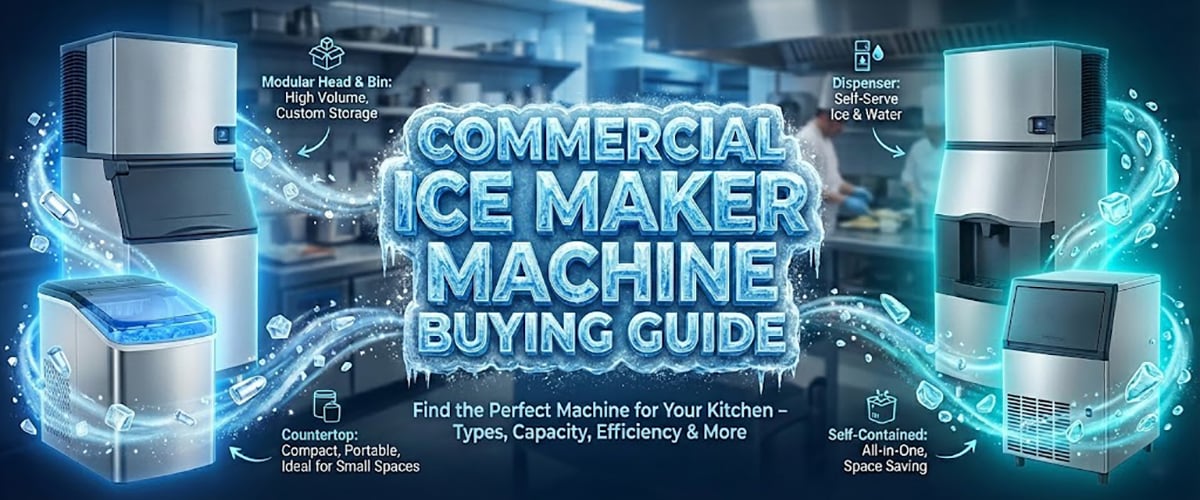
A commercial ice maker machine is one of the most essential units in almost every food service location. Making a classic iced Americano? You need one. Running a pub and shaking cocktails behind the bar? There’s no way around it. Ice makers show up in nearly every serving scenario, from cafés and QSRs to restaurants and bars.
But here’s the real question: with so many different types of commercial ice machines available online, how do you know which one is right for your business? Choosing the wrong model can mean wasted space, higher costs, or insufficient ice during daily service. In this guide, we’ll walk you through some practical guidelines to help you choose an ice maker that truly fits your operation and becomes a valuable investment. Last but not least, our guide also includes some troubleshooting tips to prevent your operation from breaking down.
What Are the Different Types of Commercial Ice Machines?
When it comes to commercial ice machines, you can’t ignore these four basic types: self-contained ice machines, modular ice machines, ice dispensers, and countertop units.
Choosing the right ice maker depends on several key factors, including your serving style, available space, ice type requirements, and daily ice consumption. Understanding these differences will help you match the right machine to your commercial setting and avoid unnecessary investment.
| Ice Machine Type | Supported Ice Types | Daily Output Capacity (kg/24h) |
| Undercounter | Full Ice types | 36 to over 127 kg/24h |
| Modular Ice Machine | Full Ice types | 250 – 1,000 kg/24h |
| Ice Dispenser | Cube, Nugget | 50 – 300 kg/24h |
| Countertop | Cube, Nugget, Bullet | 20 – 100 kg/24h |
Commercial Undercounter Ice Machines
Combine the ice maker and storage bin into one unit. If you run a small café, a hotel bar, or a boba tea shop, an undercounter unit slides perfectly beneath standard 40-inch counters. This all-in-one design makes them easy to install and operate, usually offering daily outputs ranging from 100 to 500 lbs, making them the top choice for establishments with moderate daily ice consumption.
From an operational perspective, they are popular because they require less planning, fewer components, and lower upfront investment compared to modular systems. For businesses looking for reliability, appearance, and flexibility, this type of commercial ice maker is often the safest starting point.

Modular Ice Machines
Modular ice machines feature a separate storage bin, allowing operators to adjust capacity based on actual demand. This type of commercial ice maker is widely used in hotels, hospitals, arenas, fast food chains, and catering operations where ice consumption can reach hundreds or even thousands of pounds per day.
While modular ice machines require more installation planning and space, they offer unmatched flexibility and efficiency for operations with heavy ice usage. If ice is critical to your service speed and consistency, a modular ice machine is often the most practical long-term solution.

Ice Dispensers
If you are looking for a quick solution, Ice dispensers are definitely the way to go. This style is for speed, hygiene, and self-service convenience. All you need to do is press a lever or button to dispense ice directly into cups or containers instead of contacting the ice with a scoop.
These machines are ideal for healthcare centres, convenience stores, offices, and public canteens where speed and hygiene are a focus. Many ice dispensers also combine ice and beverage dispensing in one unit, helping save space in front-of-house areas.

Countertop Ice Makers
As the most flexible and compact option among commercial ice machines, countertop ice makers are designed to fit perfectly into almost any foodservice setup. With their minimal space requirements, they can be installed on countertops or prep stations, making them ideal for operations where space is limited but ice is still essential.

Cube, Bullet, Crescent or Nugget: What Type of Ice is Best for My Menu?

Mastering the exact relationship between ice type and your beverage menu is one of the most important considerations for any foodservice operation. While the market offers various freezing methods, professional commercial kitchens typically choose from 4 core options: Cube, Bullet, Crescent, and Nugget.
Let's say you're serving top-shelf spirits or craft cocktails in a fine dining restaurant or a luxury hotel lobby, Cube or Crescent ice is the absolute meta. It melts incredibly slowly, locking in the chill without watering down premium liquors. However, if your guests are heading to a fast-casual spot or looking for that satisfying, flavour-absorbing crunch in a fountain soda, chewable Nugget ice is just dominant.
| Type of Ice | Ideal Setting | Best For |
| Cube | Restaurants, Bars, Catering | Premium spirits, craft cocktails, classic iced Americano |
| Bullet | Fine dining restaurants, Bars, Hotel lobby | Quick-service beverages, blended frappes, everyday chilling |
| Crescent | Restaurants, Bars, and convenience stores | Mixed drinks, fountain sodas, ice bagging & transport |
| Nugget | Hospitals, Convenience stores, Restaurants, Bars, Bubble tea shops | Fountain sodas, blended smoothies, therapeutic hydration |
Ice Machine Condenser Options Explained
Air-cooled, water-cooled, and remote-cooled are three common condensers used in commercial ice makers. After you confirm what kind of machine you want to purchase, choosing the right type of condensing unit is the next step.
-
Air-cooled ice machines are the most common choice in commercial kitchens. They use the surrounding air to dissipate heat and are relatively easy to install. As long as the space has proper airflow and ventilation clearance, air-cooled units are cost-effective and energy-efficient for most restaurants, cafés, and bars.
-
Water-cooled ice machines use water instead of air to remove heat. They perform consistently even in hot or poorly ventilated kitchens, but they consume more water. This option is often chosen where ambient temperatures are high or airflow is limited, though local water costs should be carefully considered.
- Remote-cooled ice machines separate the condenser from the ice maker head, placing it outdoors or on the roof. This setup significantly reduces heat and noise inside the kitchen, making it ideal for hotels, hospitals, and high-end foodservice operations with strict comfort requirements.
What is the difference among these 3 types of condensers: 3 Types of Ice Maker Condensers: Air-Cooled, Water-Cooled & Remote-Cooled
What to Consider Before Choosing an Ice Maker
Making the right decision always is a long process, during this time-consuming period, there're some important factors that are worth taking time on.
-
Business Type & Size
A small café serving iced coffee has very different ice needs compared to a hotel banquet kitchen or a public institutional kitchen. The capacity and service style of your business should guide your equipment choice.
-
Daily Ice Production
Estimating how much ice you use during peak hours helps prevent under-sizing or over-investing. Running out of ice during service can be just as costly as buying a machine that’s too large.
-
Installation Space & Ventilation Conditions
Available space, counter height, drainage access, and ventilation clearance all affect which ice maker types and condenser options are suitable for your location.
How Much Ice Do I Need for My Setting?
Choosing the right size is critical: too small and you run out during rush hour; too large and you waste energy. The industry standard for a typical restaurant is approximately 1.5 lbs (0.7 kg) of ice per customer. Here's a quick calculation formula to find your required 24-hour ice production:
Total Ice Needed = (Number of Customers × Ice per Customer) × 1.2 (Safety Buffer)
Below is a sizing guide based on your daily customer volume for standard restaurant service:
| Number of Customers | Daily Ice Needed (kg) | Recommended SHINELONG Ice Machine Type |
| 50 | 35 – 40 kg | e.g., Furnotel 36kg Undercounter Cube Ice Maker Machine |
| 100 | 68 – 82 kg | e.g., Furnotel 73kg Undercounter Cube Ice Maker Machine |
| 250 | 170 – 205 kg | e.g., Furnotel 191kg Separate Type Cube Ice Maker |
| 500 | 340 – 410 kg | e.g., Furnotel 318kg Separate Type Cube Ice Maker |
| 1000 | 680 – 820 kg | e.g., Furnotel 682kg Separate Type Cube Ice Maker |
SHINELONG Tips: For those commercial settings that need to take care of over 1000 customers, running a parallel setup of two 400kg Ice machines is the ultimate option. This built-in redundancy means even if one unit is undergoing scheduled maintenance, the other secures your baseline operation, completely crushing the risk of a kitchen shutdown.
How to Troubleshoot Commercial Ice Maker Machines
Commercial ice maker machines play an indispensable role in daily beverage service, particularly in tropical climates and luxury fine dining venues. When this critical equipment breaks down, it inflicts massive financial losses, especially in regions with underdeveloped technical infrastructure, such as parts of Africa and Southeast Asia. In this guide, we break down common commercial ice machine failures and provide a step-by-step DIY troubleshooting manual to restore your workflow instantly.
Choosing a Reliable Commercial Ice Maker Supplier
Building a partnership with a reliable commercial kitchen equipment supplier is the final step, but also one of the most critical decisions that can impact your entire setup and long-term operation.
Stable quality control should always be the baseline when selecting a commercial ice maker machine supplier. Beyond product quality, what really matters is whether the supplier can provide responsive after-sales support. This includes offering clear troubleshooting guidance when a machine breaks down and supplying replacement parts quickly when key components fail.
As a mature commercial kitchen equipment supplier in China, SHINELONG supports foodservice businesses worldwide with end-to-end kitchen solutions. Our services are built around five core needs:
- How to design a practical commercial kitchen
- What professional equipment is required
- How to install the full kitchen setup
- How to operate commercial kitchen equipment
- How to deliver reliable after-sales service.
If you still struggle with how to set up a kitchen for commercial settings, SHINELONG are here to help you.
FAQs
-
What size commercial ice maker do I need for my restaurant?
Honestly, don't just look at the daily total; look at your "rush hour" capacity. A solid rule of thumb is 1.5 lbs (0.7 kg) per seat, but you have to account for meltage and peak shifts. For example, if you're running a mid-sized spot around 100 customers per day, something like SHINELONG’s undercounter cube Ice maker (FUIM80CF), which pumps out 80 kg/24h is usually the sweet spot. Just make sure your bin can actually hold enough to get you through a Friday night.
-
What are the best commercial ice maker brands in 2026?
You’ve got the usual big names like Hoshizaki or Manitowoc, but if you're looking for the premium solution this year, Furnotel is really killing it in the global market. Under SHINELONG, the 2026 Furnotel lineup is built like a tank and avoids a lot of the crazy price markups.
-
Which commercial ice maker is best for nugget ice?
If you want that "chewable" ice everyone obsesses over, you need a dedicated nugget head. Furnotel Separate Type Nugget Ice Maker is the perfect solution covering various commercial settings like a few boba shops, restaurants, and healthcare setups; it produces that perfect, flavour-absorbing crunch without constantly jamming. You can shop all of them on SHINELONG.
-
Can you recommend the best ice machine for a small business?
If you’re tight on space and budget, the model FEIM36CF is the top pick for any small business. It’s a self-contained model, so it slides right into your prep line. It does about 36 kg/24h, which is more than enough for a boutique coffee shop or small bar. Plus, it’s quiet enough that you won’t hear it humming over your customers' conversations.
-
Where can I buy commercial ice machines near me?
You can hit up a local supply store, but they usually have limited stock and high markups. Honestly, ordering directly from a global supplier like SHINELONG is far more convenient while offering much better quality. Instead of just selling you an individual ice maker, SHINELONG delivers an end-to-end solution. Whether you are finalizing a luxury bar design or setting up a hotel kitchen, they ship their full range of ice makers—from modular units to self-service dispensers—internationally with full after-sales support. By cutting out the local middleman, you ultimately get a much higher-spec machine for the exact same budget.