After-Sales:
 EN
EN
 AR
AR
 HR
HR
 NL
NL
 FI
FI
 FR
FR
 DE
DE
 EL
EL
 HI
HI
 IT
IT
 PT
PT
 RO
RO
 RU
RU
 ES
ES
 TL
TL
 ID
ID
 SL
SL
 VI
VI
 ET
ET
 MT
MT
 TH
TH
 FA
FA
 AF
AF
 MS
MS
 IS
IS
 MK
MK
 HY
HY
 AZ
AZ
 KA
KA
 UR
UR
 BN
BN
 BS
BS
 KM
KM
 LO
LO
 LA
LA
 MN
MN
 NE
NE
 MY
MY
 UZ
UZ
 KU
KU

News
3 Types of Ice Maker Condensers: Air-Cooled, Water-Cooled & Remote-Cooled
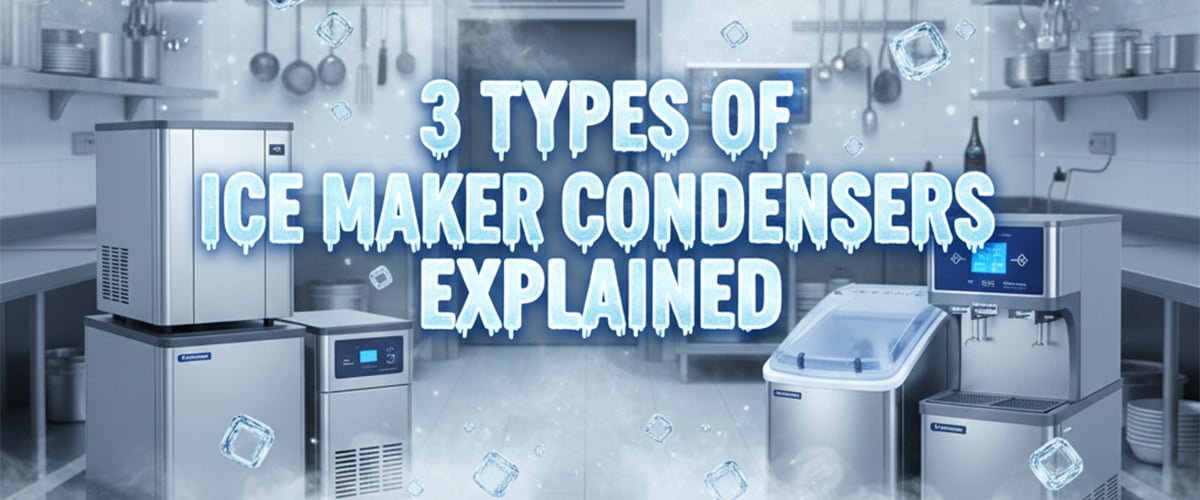
When you head to purchase a commercial ice maker machine, there are always three options: air-cooled, water-cooled, and remote-cooled ice machines. So, what’s the difference between these types of condensers, and how will they impact your foodservice location? I bet this question is messing with your decision. In this guide, we’ll walk you through the definitions, pros, cons, and applications of these three types of ice machines to help you avoid costly mistakes.
Air-Cooled Ice Machines
An air-cooled ice maker machine is typically the most common ice solution across commercial foodservice settings. In an air-cooled condenser system, refrigerant is pumped through the condenser coils while a built-in fan pulls in ambient air and blows it across the coils. This airflow removes heat from the refrigerant, allowing it to cool down before circulating back to the evaporator plate to form ice.
Because the system relies on the surrounding air to release heat, proper distance and ventilation are essential. Leaving enough space around the ice machine ensures stable performance, consistent ice production, and prevents heat buildup in the back of the house.
Pros of Air-Cooled Ice Machines
- The most affordable option to purchase, making it fit in most foodservice locations.
- Easy to install and maintain, with no complicated setup requirements.
- No additional operating costs, such as extra water consumption, which helps control utility expenses.
Cons of Air-Cooled Ice Machines
- Struggles in high ambient temperatures, especially when kitchen temperatures exceed 90°F (32°C).
- Exhausted heat is released back into the kitchen, raising back-of-house temperatures, and the fans can create consistent operating noise.
- Requires sufficient clearance (typically 6–12 inches) around the unit to ensure proper airflow and heat exchange.
Best Applications for Air-Cooled Ice Machines
Air-cooled ice machines are the most popular and widely used option across many premises, including pubs, quick-service restaurants, and dining facilities. If you choose an air-cooled model, it’s important to ensure there is enough installation space and reliable ventilation to maintain stable performance and avoid overheating issues.
Shop All the Air-cooled Ice Makers
Water-Cooled Ice Machines
Water-cooled condensers use flowing water to remove heat from the condenser coils, instead of relying on pulling in surrounding ambient air. Because water has a much higher heat transfer efficiency than air, it can pull heat away from the refrigerant quickly and consistently. This allows the ice machine to maintain stable operating temperatures even in hot environments typically more than 90℉, while the heated water is discharged directly through the drain.
Water-cooled ice machines are an ideal solution for locations with high ambient temperatures, limited ventilation, or noise-sensitive areas, such as departure lounges, indoor bars, and enclosed foodservice spaces.
Pros of Water-Cooled Ice Machines
- One of the advantages of a liquid-cooled machine is that it can operate in a hot environment.
- It would not exhaust out extra heat and it's great for the room without air conditioning.
- Without a condenser fan, these units are significantly quieter.
Cons of Water-Cooled Ice Machines
- The biggest drawback is high water consumption, which directly increases daily operating costs.
- Water quality requirements are critical. In areas with hard water, minerals such as calcium and magnesium can build up inside the water jacket. Over time, this mineral scale forms an insulating layer that reduces heat transfer efficiency and can put excessive strain on the compressor.
Best Applications for Water-Cooled Ice Machines
In summary, water-cooled ice machines are a perfect solution for high-ambient environments without air conditioning or ventilation. However, the trade-off is significantly higher water usage. For example, a 135-liter water-cooled ice machine can increase your monthly water bill by around $40, depending on local rates. In some regions with strict water conservation regulations, water-cooled ice machines may even be restricted or prohibited due to excessive water consumption.
Remote Condenser Ice Machines
The third option is a remote condenser ice machine. This design separates the condenser from the ice maker itself, with the condenser typically installed on the rooftop or exterior wall. The two components are connected by refrigerant lines. A big fan inside the remote condenser pulls in ambient air through it and cools it down.
Because the condenser is located away from the kitchen, this setup keeps heat and operating noise out of the workspace, creating a comfortable and quieter environment for staff. That’s why remote-cooled ice machines are often chosen for high-end restaurants, hotels, and facilities where comfort and noise control matter.
However, a remote condenser system is usually the most expensive option among the three types. It requires purchasing an additional condenser unit, hiring professional technicians for installation, and allowing extra budget for maintenance and repairs. This means the upfront investment for a remote-cooled ice machine is extremely substantial.
Pros of Remote-Cooled Ice Machines
- With a separate design, the condenser is installed away from the workstation, creating a quiet and comfortable zone for staff.
- No need to use a bunch of extra water but remain energy efficient.
- Running several ice makers into one condenser rack system.
Cons of Remote-Cooled Ice Machines
- The initial investment is extremely substantial.
- Have to deal with extra Maintenance and repair of refrigerant lines.
Best Applications for Remote-Cooled Ice Machines
The optimal option for massive stadiums, large hotels, and 800+ diner cafeterias, where the cumulative heat and noise of multiple machines would be unbearable.
Air-Cooled vs Water-Cooled vs Remote-Cooled Ice Machines
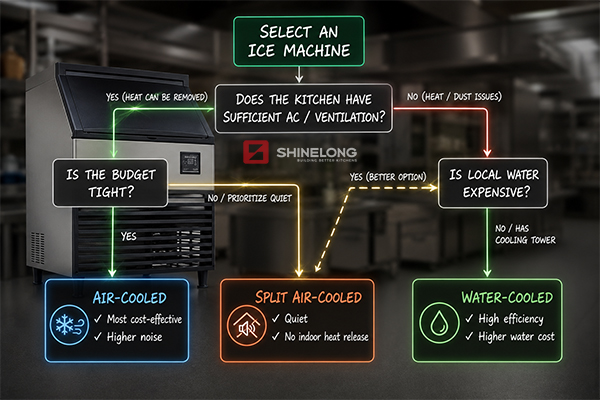
In short, selecting the appropriate Ice maker machine for a foodservice location is a tricky task. So we have compiled key information about these 3 different types of condensers into one image to explain how to make a reliable decision in the initial buying process.
Metric |
Air-cooled | Water-cooled | Remote-cooled |
Daily Ice capacity |
23-1,100kg | 135-1,110kg | 220-1,110kg |
Energy use |
Highest | Lowest | Medium |
Water use for cooling |
0L(Ice making water only) | 850-1,700L/100kg of Ice | 0L(Ice making water only) |
| Heat released indoors | Full load, 17,000–51,000 BTU/hr | Almost none (heat leaves with drain water) | None (heat released outdoors) |
*Energy consumption figures are rough estimates for reference only and will vary by region, machine capacity, and installer. Confirm with a local quote before publishing exact numbers.
Key Data You Should Know Before Buying
1. Water-cooled machines use a lot more water than you'd expect.
On an air-cooled or remote-cooled machine, the only water used is for making the ice itself, roughly 100–120 liters per 100 kg of ice, with no separate cooling water needed. A water-cooled machine needs an additional 850–1,700 liters per 100 kg of ice, on top of that, just to cool the condenser. Unless your building has a closed-loop cooling tower, this can meaningfully raise your water bill in areas with high water rates.
2. Ambient temperature changes performance more than most buyers realize.
Once room temperature climbs above 32°C, an air-cooled ice machine's output can drop by 15–25%. A water-cooled unit, by contrast, holds close to 100% output as long as incoming water stays around 21°C, regardless of how hot the kitchen gets.
How to Choose the Right Condenser Type
| Scenario | Recommend Types |
Why |
| Quick service restaurant, fast food franchise or grocery store | Air-cooled |
Lowest upfront cost, simplest install, and maintenance |
| Hotel lounge or fine-dining kitchen, noise/heat-sensitive foodservice operations | Remote-cooled |
Keeps heat and fan noise out of the front-of-house, open kitchen or bar area |
| Dusty or unventilated kitchen (e.g., near flour/prep stations, bakery kitchen, no A/C) | Water-cooled |
Air-cooled coils can clog with dust/flour within a month and shut the machine down; water-cooled units are largely unaffected |
*SHINELONG Commercial Ice Maker Buying Guide:https://www.chinashinelong.com/commercial-ice-maker-machine-buying-guide-shinelong
FAQs
-
Which is cheaper to buy, an air-cooled or water-cooled ice machine?
It depends on the final situation. Air-cooled machines have the lowest upfront cost and easier maintenance. Water-cooled units typically add a few hundred dollars to the base price for the water-cooling components, though the biggest cost difference shows up later in monthly water usage rather than the purchase price.
-
Do water-cooled ice machines waste a lot of water?
Absolutely. A water-cooled machine roughly consumes 850–1,700 liters of extra water for every 100 kg of ice it produces, on top of the water used to make the ice itself. In areas with water restrictions or high utility rates, this can add real cost over time.
-
Can I use an air-cooled ice machine in a hot kitchen without A/C?
You, but there's no recommendation cause it reduces output, and capacity can drop 15–25% once room temperature passes 32°C. That means it will cost your kitchen more energy and time to produce the same capacity. If your kitchen regularly runs hot and lacks air conditioning, a water-cooled machine will hold its full capacity more reliably.
-
Is a remote-cooled ice machine worth the extra cost?
It depends on your priorities. Remote-cooled systems cost more to install because they require an outdoor condenser and professional setup, but they remove heat and noise from the kitchen or station entirely, which matters most in noise-sensitive, high-end, or space-constrained environments.
-
Can you recommend reliable brands for commercial ice makers?
It depends on two things: what you serve and where you serve. What you serve refers to the drinks on your menu, which affects the ice type you need. Where you serve refers to the type of restaurant you run; for example, a fast-food restaurant typically wants an ice machine that's budget-friendly and easy to maintain, while a fine-dining restaurant prioritizes quiet operation with no extra heat release. SHINELONG offers a wide range of ice machines covering different ice types, condenser types, and capacities to fit almost any foodservice location.
-
Where can I find reliable suppliers for commercial Ice maker machines?
Look for suppliers that offer clear warranty terms, a fast spare-parts response, and relevant certifications. SHINELONG kitchen equipment is built around exactly these standards, backed by a 1-year warranty and 24-hour service response.