After-Sales:
 EN
EN
 AR
AR
 HR
HR
 NL
NL
 FI
FI
 FR
FR
 DE
DE
 EL
EL
 HI
HI
 IT
IT
 PT
PT
 RO
RO
 RU
RU
 ES
ES
 TL
TL
 ID
ID
 SL
SL
 VI
VI
 ET
ET
 MT
MT
 TH
TH
 FA
FA
 AF
AF
 MS
MS
 IS
IS
 MK
MK
 HY
HY
 AZ
AZ
 KA
KA
 UR
UR
 BN
BN
 BS
BS
 KM
KM
 LO
LO
 LA
LA
 MN
MN
 NE
NE
 MY
MY
 UZ
UZ
 KU
KU


News
Restaurant Kitchen Design: 6 Key Back-of-House Details
Designing a restaurant kitchen is one of the most critical steps when building a foodservice business. A well-planned restaurant kitchen design directly affects workflow efficiency, staff comfort, and long-term operating costs.
As the operational area of a restaurant, the back-of-house (BOH) is where every dish comes to life. It carries the responsibility of consistent production under pressure, which naturally brings a unique set of design challenges. Therefore, while practicality and hygiene are basic requirements, remember that running a restaurant is a demanding business: every minute counts, and it's all about the money.
In this article, we will share tips on designing an efficient and clean commercial kitchen, covering key details from space planning and layouts to wall cladding and ceiling specifications.
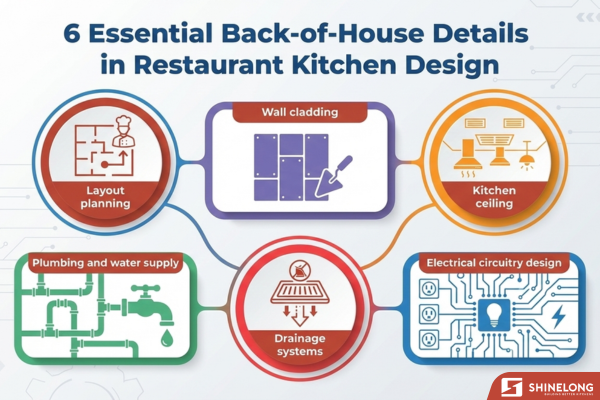
6 Back-of-House Details in Restaurant Kitchen Design
Regardless of concept or cuisine, some fundamentals apply to almost all popular types of restaurants. A well-thought-out kitchen layout of restaurant operations always comes down to these six areas:
- Layout planning
- Wall cladding
- Kitchen ceiling
- Plumbing and water supply
- Drainage systems
- Electrical circuitry design
Each one affects how safely, efficiently, and profitably your kitchen runs.
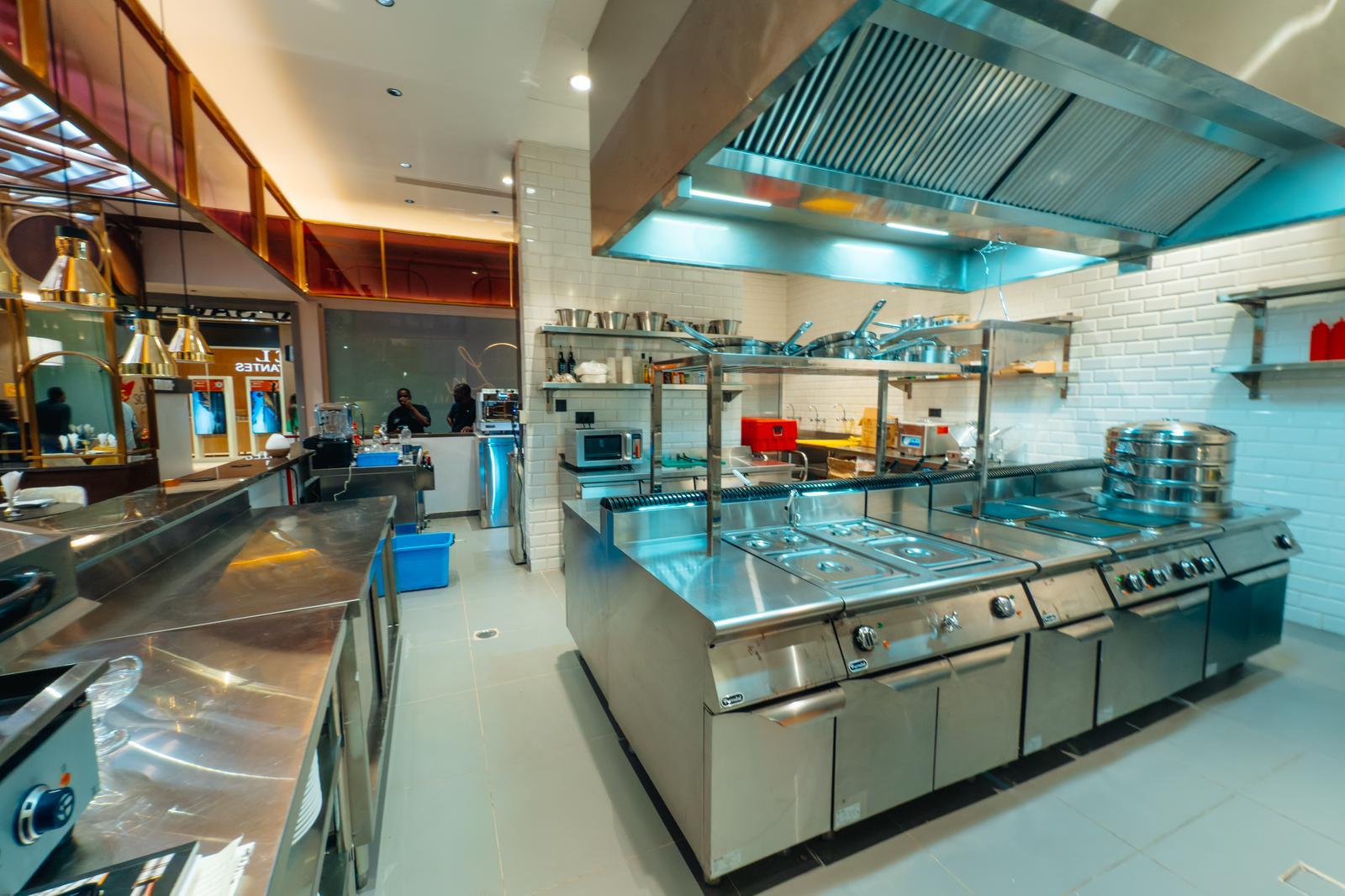
1. Layout Planning
Space ratio is the starting point of any restaurant kitchen plan. For casual dining restaurants, a dining-to-kitchen ratio of around 1:1 is common. Fine dining restaurants, where guest experience and atmosphere take priority, often operate closer to a 2:1 ratio. That said, there is no single fixed rule. Local regulations, service style, and menu complexity all play a role.
In practice, a full-service restaurant should generally avoid a less than a 4:6 ratio for dining to kitchen. Limited kitchens almost always struggle during rush hours.
More important than size alone is workflow. Storage, prep, cooking, service, and cleaning should follow a logical sequence with minimal cross-traffic. While there is no universal “perfect” commercial kitchen floor plan, one proven principle is to anchor the hot line at the center of operations. In most professional kitchens, the cooking line typically occupies around 45% of the BOH area, supporting speed, coordination, and output consistency.
2. Wall cladding
Kitchen wall cladding plays a much bigger role than aesthetics. In professional restaurant kitchen design, wall finishes must be non-toxic, odor-free, waterproof, smooth, and resistant to grease buildup. Light-colored materials are preferred because they reveal dirt quickly and support hygiene inspections.
At junctions where walls meet floors or ceilings, rounded coving with a radius of at least 3 cm is strongly recommended. This prevents dirt accumulation and makes daily cleaning far more effective. In wet or frequently washed areas, wall cladding should extend at least 1.5 meters high using durable, non-absorbent materials such as ceramic tiles or metal composite panels. For dedicated prep rooms, extending cladding all the way to the ceiling is often the safest option.
3. Kitchen ceiling
Ceiling design is often underestimated in restaurant kitchen layouts. Ideally, the ceiling height should be no lower than 2.5 meters to allow proper ventilation and heat dissipation. Where exposed pipes or uneven structures exist, a sealed suspended ceiling can help create a clean, washable surface.
Materials should be non-toxic, moisture-resistant, corrosion-resistant, and easy to clean. In high-humidity areas, a slight ceiling slope helps prevent condensation from dripping onto food or work surfaces, an issue frequently flagged during health inspections.
4. Plumbing and water supply
Every cooking station should have convenient access to water. Install the right type of faucets near the hot line to improve efficiency during cooking and cleaning, reducing unnecessary movement.
In cleaning areas, hands-free faucets such as foot-operated, elbow-controlled, or sensor-activated models are strongly recommended. These fixtures support hygiene standards while improving workflow speed. Cold and hot water supply should be stable and sufficient to handle peak service demand without pressure drops.
Guide to Buy Commercial Kitchen Faucets
5. Drainage systems
Drainage design is a technical but critical part of any industrial restaurant kitchen. Floors must drain efficiently, and open drainage channels should be avoided in clean operation zones. Where open drains are unavoidable, they must be covered with removable grates.
Drain channels should better feature rounded internal corners with a minimum radius of 3 cm to prevent grease buildup. Grease traps are mandatory for oily wastewater, and all drainage systems must include backflow prevention to avoid contamination. A proper slope ensures water flows smoothly without pooling, which helps maintain safety and sanitation.
6. Electrical circuitry design
Commercial kitchens operate under high heat, humidity, and constant equipment loads. Electrical systems must be designed accordingly. Concealed wiring is strongly preferred. When surface installation is unavoidable, cables should be protected with insulated, flame-retardant conduits securely fixed in place.
Circuit zoning should match equipment power demand to prevent overloads, and all installations must comply with local electrical safety codes. Reliable electrical design protects both staff and equipment over the long term.
If you want to learn more about how to design the entire kitchen for a restaurant step by step, check this article: How to Design Restaurant Kitchen Floor Plans: From Zero to One