After-Sales:
 EN
EN
 AR
AR
 HR
HR
 NL
NL
 FI
FI
 FR
FR
 DE
DE
 EL
EL
 HI
HI
 IT
IT
 PT
PT
 RO
RO
 RU
RU
 ES
ES
 TL
TL
 ID
ID
 SL
SL
 VI
VI
 ET
ET
 MT
MT
 TH
TH
 FA
FA
 AF
AF
 MS
MS
 IS
IS
 MK
MK
 HY
HY
 AZ
AZ
 KA
KA
 UR
UR
 BN
BN
 BS
BS
 KM
KM
 LO
LO
 LA
LA
 MN
MN
 NE
NE
 MY
MY
 UZ
UZ
 KU
KU


News
What are the types of commercial range hoods?
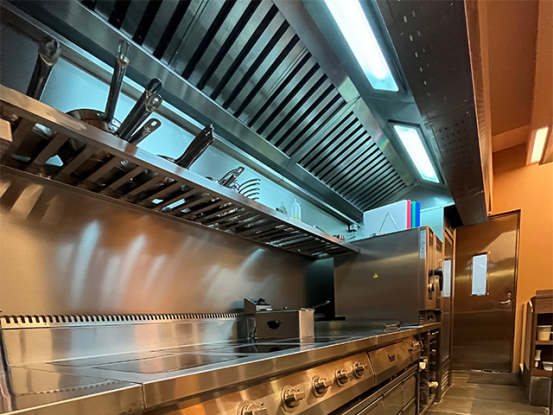
Why the Commercial Range Hood Is the Unsung Backbone of Kitchen Safety
The commercial range hood is the unsung hero of every professional kitchen. It operates continuously for 12 to 16 hours a day, removing heat, smoke, grease, steam, and combustion byproducts from the cooking environment — and when it fails, the entire kitchen grinds to a halt, either because staff cannot work in the resulting conditions or because the fire suppression system interlocks with the exhaust and shuts down the cooking equipment. Understanding the different types of commercial range hoods, their applications, and their engineering requirements is essential for anyone designing, building, or renovating a commercial kitchen.
Type I vs. Type II Hoods: The Fundamental Classification System
The primary classification of commercial range hoods divides them into Type I and Type II, a distinction based on what they are designed to capture. Type I hoods, also known as grease hoods, are engineered to collect and remove grease-laden vapors produced by cooking equipment that uses oils, fats, or solid fuels. This category covers hoods installed over fryers, griddles, charbroilers, wok ranges, tilting skillets, and solid-fuel equipment such as wood-fired ovens. Type I hoods incorporate grease extraction features — baffle filters, grease cups, and sloped collection channels — and must be connected to a fire suppression system because the accumulated grease represents a significant fire hazard.
Type II hoods, also called condensate or heat hoods, handle steam, heat, and water vapor from equipment that does not produce grease-laden emissions: dishwashers, steamers, pasta cookers, and ovens that operate below grease-vaporization temperatures. Type II hoods do not require fire suppression, but they do require condensate drainage to prevent water from dripping back onto equipment or food. In most jurisdictions, the distinction between Type I and Type II is codified in mechanical codes such as the International Mechanical Code (IMC) Chapter 5 or NFPA 96, and misclassifying a Type I application as Type II is one of the most expensive code violations in commercial kitchen construction because it typically requires a full hood replacement rather than a retrofit.
Mounting Configurations: Wall-Mounted, Island, and Proximity Hoods Compared
Beyond the Type I/II classification, commercial range hoods are categorized by their mounting configuration, which determines how they integrate with the kitchen layout and building structure. Wall-mounted canopy hoods are the most common configuration in commercial kitchens. They are mounted against a wall with the cooking equipment positioned directly beneath them along the same wall, and they capture rising effluent through a canopy that extends over the front and sides of the equipment. The canopy depth must exceed the equipment footprint — typically by 150 to 300 mm on the front and sides — to capture thermal plumes that spread as they rise. Wall-mounted canopies are the default choice for standard back-of-house cooking lines because they are the most space-efficient configuration for cooking equipment placed against walls.
SHINELONG's stainless steel hood systems, deployed in hotel kitchens from Ibis Lagos Lekki to the Pullman Hotels and Resorts properties, include custom-fabricated wall-mounted canopies sized to the exact equipment layout rather than off-the-shelf standard dimensions, ensuring complete effluent capture without oversizing the exhaust system. Clients can explore custom setups in our full collection of commercial restaurant equipment.
Island Canopy Hoods: Design for Open-Show and Center-Island Cooking Stations
Island canopy hoods serve cooking equipment positioned away from walls — a configuration increasingly common in open-show kitchens, teppanyaki stations, and hotel buffet live-cooking areas where the culinary action is part of the guest experience. Island hoods are suspended from the ceiling over the cooking island and must capture effluent from all four sides, which makes them aerodynamically more demanding than wall-mounted hoods. The capture area must extend beyond the equipment on every side, and the exhaust volume — measured in cubic feet per minute or cubic meters per hour — is typically 20-30% higher than a wall-mounted hood covering the same equipment because cross-drafts from air conditioning, open doors, and guest movement can disrupt the thermal plume from multiple directions.
Island hoods also place heavier structural demands on the ceiling, requiring engineered support frames and, in many cases, integrated fire suppression piping routed through the ceiling cavity. For the Radisson Resort & Suites Phuket, SHINELONG's ventilation design included island canopy hoods over the resort's open-kitchen teppanyaki and seafood grill stations, with computational fluid dynamics analysis ensuring that cooking emissions were captured without creating uncomfortable drafts at the guest seating that surrounded the cooking stations.
Proximity Hoods: Compact Ventilation Solutions for Space-Constrained Kitchens
Proximity hoods, also called backshelf or low-proximity hoods, represent a specialized category designed for equipment that generates relatively low heat and grease output — electric convection ovens, steamers, and some countertop cooking equipment — in kitchens with limited ceiling height or where a full canopy would obstruct sightlines. Proximity hoods are mounted close to the cooking surface, typically 450 to 900 mm above it, and rely on high-velocity capture rather than thermal buoyancy to collect effluent. Their compact profile makes them suitable for display cooking in retail food courts, compact hotel pantry kitchens, and satellite kitchen stations where space is extremely limited. However, they are not suitable for high-grease equipment like charbroilers or woks, and specifying them incorrectly is another common and costly mistake.
Ventless and Recirculating Hoods: Technology for Non-Traditional Food Service Spaces
Ventless or recirculating hoods are a growing category driven by the expansion of food service into non-traditional spaces — retail stores, office lobbies, airport kiosks, and co-working spaces — where cutting ductwork through the building structure is either impossible or prohibitively expensive. Ventless hoods use a multi-stage filtration system: a grease filter, a HEPA or electrostatic precipitator for smoke and fine particulate removal, and often an activated carbon stage for odor control, before recirculating the cleaned air back into the room. Because no air is exhausted to the outside, ventless hoods eliminate the need for makeup air and significantly reduce HVAC load.
However, they are restricted to electric cooking equipment with limited grease production — they cannot serve gas-fired equipment under most mechanical codes — and they add ongoing filter replacement costs that do not apply to ducted systems. SHINELONG's design consultancy evaluates whether ventless or ducted hoods are the right choice for each specific application, factoring in equipment type, available building infrastructure, local code requirements, and the total lifecycle cost rather than just the upfront equipment price.
Material Specifications: Stainless Steel Grades and Hood Longevity Factors
The material specification of a commercial range hood directly impacts its longevity, cleanability, and code compliance. The industry standard is stainless steel, but not all stainless steel is equal. Type 304 stainless steel, with 18% chromium and 8% nickel content, offers excellent corrosion resistance and is the default choice for most commercial hood applications. Type 430 stainless steel, a lower-cost ferritic grade with 16-18% chromium and no nickel, offers adequate performance for Type II hoods in less corrosive environments but should not be used for Type I grease hoods in high-humidity or coastal installations where chloride-induced pitting can occur.
Hood thickness is specified by gauge — 18-gauge (1.2 mm) for the hood body and 16-gauge (1.5 mm) for welded seams and structural supports is standard, though some jurisdictions require 16-gauge throughout for Type I hoods. SHINELONG's Premium and Premium Plus equipment tiers, featured across our range of commercial hotel kitchen equipment, use 304-grade stainless steel with anti-fingerprint coating on visible surfaces for hoods installed in open kitchens where appearance matters as much as performance.
Fire Suppression, Makeup Air, and Duct Design: The Engineering Triad
Fire suppression integration, makeup air coordination, and duct design are the three engineering systems that must be designed concurrently with the hood selection — not sequentially. The fire suppression system, typically a wet chemical system compliant with UL 300, must be sized to cover every heat-producing appliance under the hood with dedicated nozzles positioned according to the manufacturer's listed coverage pattern. If a new piece of equipment is later added under the hood, the fire suppression system must be re-engineered — another reason why hood specification should be treated as a system design exercise, not a catalog purchase.
Makeup air, the conditioned or unconditioned air supplied to replace exhausted air, must be introduced at a rate of approximately 80-90% of the exhaust volume to maintain building pressurization. The introduction method matters: makeup air discharged directly into the hood cavity can disrupt the thermal plume and reduce capture efficiency, while makeup air introduced through perforated ceiling panels or low-velocity diffusers away from the hood preserves capture performance. Exhaust ductwork must be constructed of 16-gauge minimum carbon steel or stainless steel for Type I hoods, with welded liquid-tight seams, continuous slope back to the hood for grease drainage, and access doors for cleaning at intervals specified by NFPA 96 — typically every 3.6 meters of horizontal duct and at each change of direction.
Frequently Asked Questions (FAQs)
What is the difference between a Type 1 and Type 2 commercial range hood?
A Type 1 hood is a grease-rated hood designed for cooking equipment that produces grease-laden vapors — fryers, griddles, charbroilers, woks — and it must include grease extraction filters, a grease drainage system, and integration with a fire suppression system. A Type 2 hood is a condensate and heat-rated hood for equipment that produces steam, heat, and water vapor but no grease — dishwashers, steamers, pasta cookers, and low-temperature ovens — and it requires condensate drainage but no fire suppression. Misclassifying a grease-producing appliance as Type 2 is a serious code violation that usually requires full hood replacement.
Can I use a ventless commercial range hood for my restaurant?
Ventless hoods can be used in restaurants but only under specific conditions: the cooking equipment must be electric (not gas-fired), the menu must limit grease production to levels the multi-stage filtration system can handle, local mechanical and fire codes must explicitly permit ventless operation, and the hood must be UL 710B listed for recirculating operation. Ventless hoods are most practical for display cooking in retail settings, compact cafés without duct access, and limited-menu concepts rather than full-production restaurant kitchens. They add ongoing filter replacement costs and require strict adherence to the manufacturer's daily and weekly cleaning schedule.
How often should commercial range hoods be cleaned?
Commercial range hood cleaning frequency depends on cooking volume and fuel type. NFPA 96 requires inspection and cleaning on a schedule determined by the volume of grease-laden vapor produced: monthly for solid-fuel cooking and high-volume charbroiling, quarterly for moderate-volume operations using gas or electric fryers and griddles, semi-annually for low-volume operations like churches and seasonal facilities, and annually for Type II hoods over non-grease-producing equipment. The exhaust ductwork must be cleaned from the hood to the exhaust fan, and all access panels specified on the original hood design must be used during cleaning to ensure complete grease removal from duct interiors.