After-Sales:
 EN
EN
 AR
AR
 HR
HR
 NL
NL
 FI
FI
 FR
FR
 DE
DE
 EL
EL
 HI
HI
 IT
IT
 PT
PT
 RO
RO
 RU
RU
 ES
ES
 TL
TL
 ID
ID
 SL
SL
 VI
VI
 ET
ET
 MT
MT
 TH
TH
 FA
FA
 AF
AF
 MS
MS
 IS
IS
 MK
MK
 HY
HY
 AZ
AZ
 KA
KA
 UR
UR
 BN
BN
 BS
BS
 KM
KM
 LO
LO
 LA
LA
 MN
MN
 NE
NE
 MY
MY
 UZ
UZ
 KU
KU


News
Commercial Kitchen Range Hoods: The Ultimate Guide to Ventilation, Sizing & Costs
When it comes to designing an efficient hot line for the starving foodie, powerful commercial ranges undoubtedly play the key role. But quietly doing the heavy lifting behind the scenes is the commercial range hood, keeping the entire cooking area clean and safe by pulling smoke, grease, heat, and steam out of the air, so chefs and staff can actually breathe, equipment can run efficiently, and the place never becomes a fire hazard.
This guide covers everything worth knowing about commercial kitchen range hoods, from understanding the parts and types to sizing it right, picking materials, staying compliant, and figuring out what it'll actually cost.
What Is a Commercial Kitchen Range Hood?
A commercial kitchen range hood, also known as a commercial exhaust hood, restaurant hood, or kitchen exhaust hood, is a ventilation system installed above cooking equipment to capture and remove airborne contaminants produced during cooking. That means grease particles, smoke, heat, steam, and odors, all of it. Here's the thing: commercial hoods are not just a bigger version of what's hanging above a home stove. They're built for heavy, sustained use, moving significantly more air, measured in CFM (cubic feet per minute), and must meet strict fire safety and building codes that residential units simply aren't held to.
| Feature | Residential Hood | Commercial Hood |
| CFM Range | 200–600 CFM | 1,000–10,000+ CFM |
| Grease Management | Basic mesh filter | Baffle filters + grease troughs |
| Fire Suppression | Not required | Required for Type 1 (grease) |
| Material | Plastic or Stainless steel | Stainless steel or Cast iron |
Key Parts of a Commercial Range Hood
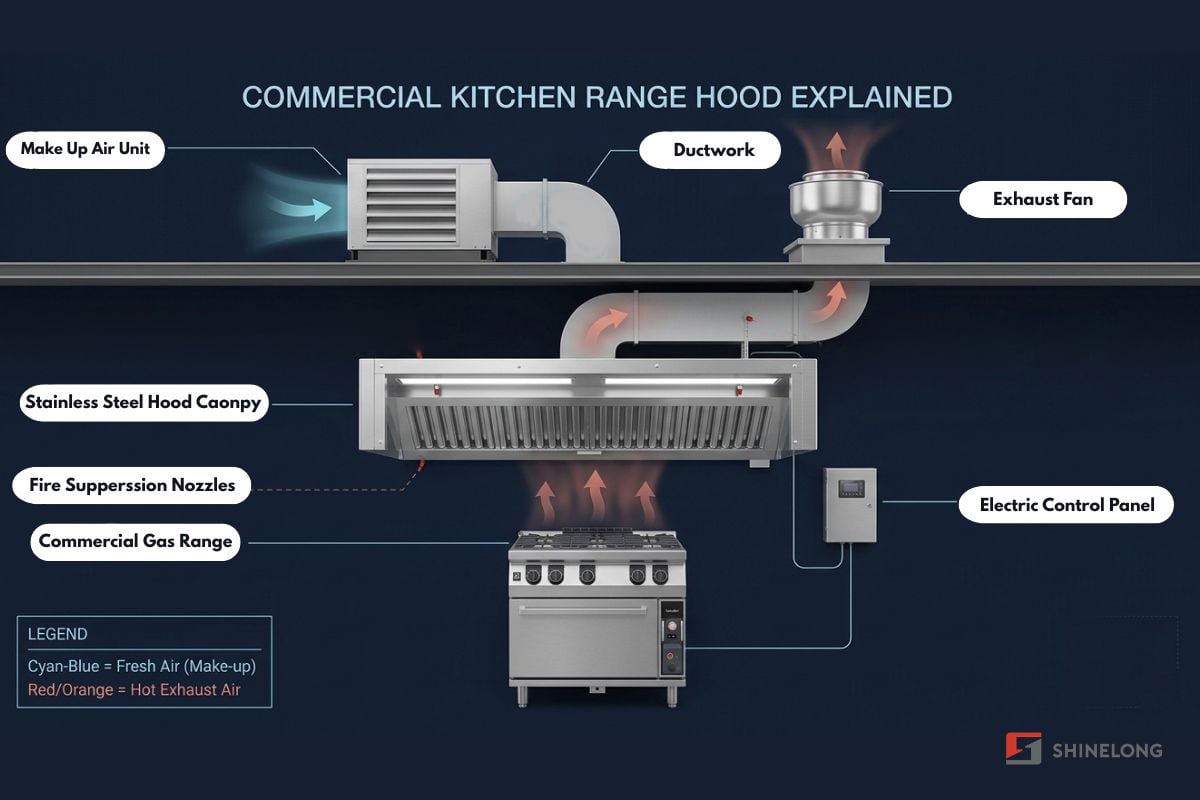
A commercial hood is more than a metal box on the ceiling. It's a complete ventilation system with several working parts, each doing a specific job:
- Hood Unit: The main structure, usually stainless steel, that sits above the cooking equipment and collects rising contaminants.
- Grease Filters (Baffle or Mesh): Mounted inside the canopy, these trap grease particles before they enter the ductwork. Baffle filters are the commercial standard, more efficient and easier to clean than mesh.
- Grease Collection Trough & Drain: Channels captured grease downward into a removable collection cup. Critical for preventing grease buildup and fire risk.
- Exhaust Plenum & Ductwork Connection: The plenum is the chamber that distributes airflow evenly before it exits through the duct.
- Exhaust Fan: The motor that creates the negative pressure to pull air through the system. Can be roof-mounted or inline.
- Make-Up Air System: Supplies fresh replacement air to compensate for what's being exhausted.
- Fire Suppression System: Required for Type 1 hoods. Automatically discharges suppressant onto cooking equipment when a fire is detected.
Type 1 vs. Type 2 Hoods: What's the Difference & Which One Do You Need?
After understanding the significance of a range hood in a commercial kitchen, here comes another question: how to choose the right one for the operation? There are 2 types of hoods available in ventilation systems, and to be honest, this decision really comes down to one question: what cooking equipment is sitting under the hood?
-
Type 1 Hoods, Optimal for Grease
Type 1 hoods are an ideal solution for heavy-duty cooking equipment that produces grease and smoke, commercial ranges, fryers, wok ranges, and grills. This kind of equipment generates massive grease and extra smoke during the heavy cooking process, which means Type 1 hoods must include grease filters, grease troughs, and a fire suppression system. When installing a hood over a hot line, a Type 1 hood isn't optional. It's required by every local fire and health code. -
Type 2 Hoods, Best for Heat, Steam & Odor
Type 2 hoods handle heat, moisture, steam, and odors. They work over equipment like commercial dishwashers, steamers, non-grease-producing ovens, and warming stations. No grease filtration or fire suppression required.
Quick way to identify which type fits: grease coming off the equipment means Type 1. Heat and steam only, Type 2 may be enough, but no matter which type you look for, always verify with local code first.
How to Size a Commercial Range Hood
Sizing is where a lot of kitchens get it wrong. Too small, and the hood can't keep up with the heat and grease. Too large, and energy costs climb unnecessarily. Neither outcome is good. There are three core elements to get right: overhang, CFM, and air balance.
The Overhang Rule
The golden rule for sizing a hood's physical footprint is simple: the canopy must extend at least 12 inches beyond the cooking equipment on all open sides. An easy way to get this right is to measure the total length of the entire cooking equipment line, then add 12 inches. That final number is the overall dimension of the canopy, with a 6-inch overhang on both sides. This ensures every bit of rising grease and smoke gets captured before it escapes into the kitchen. If the space is limited and can't hit that mark, vertical end panels can fill the gap, creating a barrier that forces the air exactly where it belongs. One more thing: don't hang it so high that it's just ventilating the ceiling. Keep the hood between 30 and 42 inches above the commercial cooking appliances for maximum capture efficiency.
CFM: How Much Airflow Is Actually Needed
CFM (cubic feet per minute) is the measure of a range hood's suction power, essentially, how much air the hood can move per minute. There are two common ways to calculate the right number:
-
BTU Method
This one works best for commercial gas ranges. Add up the BTUs of every single burner, then divide by 100; that's the minimum CFM needed. For example, a 60,000 BTU stovetop needs at least 600 CFM (60,000 ÷ 100). Simple and straightforward. -
The Linear Foot Method
The most common approach in the industry. The key here is that you're not measuring the equipment length; you're measuring the hood length, which should already extend at least 12 inches beyond the total cooking line. Once that number is confirmed, multiply it by the Duty Rating of the equipment. The formula is right here: "Hood Length (ft) × CFM per Linear Foot = Total CFM."
Cooking Equipment Ratings Reference:
- Medium-Duty (ranges, griddles): 300 CFM/ft
- Heavy-Duty (woks, charbroilers): 350–400 CFM/ft
- Light-Duty (pasta cookers, ovens): 250 CFM/ft
If you are still confused about the CFM calculation, this blog definitely could help you out: How to Calculate Extraction Rate for Commercial Kitchen Ventilation
Ducted vs. Ductless: Pros, Cons & When to Use Each
Most commercial kitchens run ducted systems. But ductless options exist, and in some situations they're worth considering.
-
Ducted Commercial Hoods
Ducted hoods vent contaminated air directly outside the building through a duct system. This is the industry standard for heavy cooking operations and for any equipment that produces massive grease; it's effectively the only compliant option. Grease-laden air needs to exit the building, not recirculate through a filter. -
Ductless Commercial Hoods
Ductless hoods use filtration (typically activated carbon) to clean the air and recirculate it back into the kitchen. They're easier to install, no ductwork required, but have real limitations. It is typically suitable for some light cooking units but is not an option for a whole commercial kitchen setup or heavy-duty cooking equipment. They're generally not code-compliant over grease-producing equipment and require frequent and costly filter replacements.
Materials & Filter Types
Stainless steel is always the go-to solution in the commercial kitchen standard. It's non-porous (doesn't absorb grease or bacteria), easy to clean, corrosion-resistant, and durable enough to handle years of heat exposure. Most codes require it for Type 1 applications.
Baffle Filters vs. Mesh Filters
- Baffle Filters: The commercial standard. Baffled channels cause grease-laden air to change direction, forcing grease particles to drop into a collection trough. More efficient, easier to clean (dishwasher-safe in most cases), and required by many codes.
- Mesh Filters: Found in older or lower-cost systems. Less efficient at grease capture, harder to clean thoroughly, and not permitted by NFPA 96 in many Type 1 applications. If mesh filters are still in place, it's time for an upgrade.
Make-Up Air: The Part Most People Forget
Here's something that surprises a lot of first-time commercial kitchen designers: for every cubic foot of air the hood exhausts, a cubic foot of replacement air has to come from somewhere. That replacement air is called make-up air (MUA), and without a proper make-up air system, a few things go wrong fast:
- Negative pressure builds up inside the kitchen, making doors hard to open
- The exhaust system can't pull air efficiently, resulting in a drop in performance
- Backdrafting can occur, pushing combustion gases from gas appliances back into the kitchen
- Energy costs spike as the HVAC system fights against the pressure imbalance
Make-up air is typically supplied at around 80–90% of the exhaust volume, with the remainder drawn from adjacent spaces. It can be delivered tempered (heated or cooled to a comfortable temperature) or untempered (raw outside air). In cold climates, untempered make-up air in winter is brutal, and tempered systems are worth the investment.
SHINELONG tip: integrate the make-up air system with the hood controls so they ramp up and down together. Running the exhaust full blast while the MUA is off is a common and avoidable mistake.
Cleaning & Maintenance Schedule
Grease buildup in hoods and ducts is one of the leading causes of commercial kitchen fires. Regular cleaning isn't just good hygiene; it's a code requirement under some local paperwork and a core part of any serious kitchen operation.
How often
| Cooking Volume | Recommended Cleaning Frequency |
| High-volume (hotel kitchen, quick service restaurant, 24/7 operation) | Monthly |
| Moderate volume (daily full-service restaurant, casual restaurant) | Quarterly |
| Low volume (churches, day camps, seasonal kitchens) | Annually |
What Gets Cleaned?
- Grease filters: Should be removed and washed regularly; ideally weekly in high-volume kitchens. Most baffle filters are dishwasher-safe.
- Grease collection cups/troughs: Empty and clean frequently. A full grease cup is a fire waiting to happen.
- Hood canopy and interior: Full degreasing at every scheduled cleaning interval.
- Ductwork and exhaust fan: Full duct cleaning by a certified professional. This is not a DIY job.
How Much Does a Commercial Range Hood Cost?
Costs vary significantly based on hood size, type, configuration, and local labor rates. Here's a realistic breakdown:
| Component | Budget Range | Notes |
| Hood Unit (standard or wall canopy) | $500 – $3,000 | Basic stainless Type 1 |
| Hood Unit (island or custom) | $3,000 – $10,000+ | Size and complexity dependent |
| Installation (labor + ductwork) | $2,000 – $8,000 | Varies by duct run length |
| Make-Up Air System | $1,600 – $10,000 | Tempered MUA costs more |
| Fire Suppression System | $1,500 – $4,000 | Required for Type 1 |
| Exhaust Fan | $1000 – $3,000 | Roof-mounted or inline |
| Total (typical full system) | $8,000 – $30,000+ | Complete installed system |
Budget hoods exist, but in commercial kitchens, this isn't the place to cut corners. A cheap hood that fails a fire inspection or can't keep up with a busy service will cost far more in the long run than a quality system upfront.
Make the Right Decision Before Setting Up Your Kitchen
There is no doubt that the commercial kitchen range hood plays a key role in the back of house, determining whether the kitchen is safe, functional, and compliant. But setting up a complete ventilation system means considering a lot of moving parts: commercial kitchen layout, cooking line configuration, menu design, and even initial budget.
At SHINELONG, when it comes to building a cooking station for a new foodservice establishment, they deliver a comprehensive kitchen solution covering the full investment — kitchen design, equipment supply from cooking appliances to range hoods, and installation. The goal is simple: help operators make the right decision without wasting a single dollar.
At the end of the day, a commercial kitchen range hood is the safety fence protecting both the staff and the property.
FAQs
-
What is CFM, and why does it matter for installing a commercial range hood?
CFM (cubic feet per minute) measures how much air a range hood can move per minute, in other words, its suction power. Getting the CFM right is critical: too low, and the hood can't keep up with the grease and smoke; too high, and energy costs climb for no reason. For commercial kitchens, CFM is calculated either by the BTU method (total BTUs ÷ 100) or the Linear Foot Method (hood length × duty rating). Heavy-duty equipment like woks and charbroilers can demand 350–400 CFM per linear foot, so don't underestimate the number.
-
What is the difference between Type 1 and Type 2 commercial range hoods?
Type 1 hoods are built for heavy-duty equipment that generates grease and smoke. Type 2 hoods, on the other hand, handle heat, steam, moisture, and odors.
-
How often should a commercial kitchen range hood be cleaned?
It depends on the cooking volume. High-volume operations like hotel kitchens, quick service restaurants, and 24/7 operations should be cleaned monthly. Full-service and casual restaurants running daily service should be cleaned quarterly. Lower-volume operations like seasonal kitchens or institutional dining can be cleaned annually. Every cleaning should cover grease filters, collection troughs, the hood canopy and interior, and ductwork. Duct cleaning in particular, is not a DIY job; it requires calling a professional service.