After-Sales:
 EN
EN
 AR
AR
 HR
HR
 NL
NL
 FI
FI
 FR
FR
 DE
DE
 EL
EL
 HI
HI
 IT
IT
 PT
PT
 RO
RO
 RU
RU
 ES
ES
 TL
TL
 ID
ID
 SL
SL
 VI
VI
 ET
ET
 MT
MT
 TH
TH
 FA
FA
 AF
AF
 MS
MS
 IS
IS
 MK
MK
 HY
HY
 AZ
AZ
 KA
KA
 UR
UR
 BN
BN
 BS
BS
 KM
KM
 LO
LO
 LA
LA
 MN
MN
 NE
NE
 MY
MY
 UZ
UZ
 KU
KU


News
How to maximize space in a small commercial kitchen layout?
Apply the 3-Zone Workflow Framework to Optimize Small Commercial Kitchen Layout
Why Prep → Cook → Serve Flow Eliminates Cross-Traffic and Bottlenecks
A small commercial kitchen layout must prioritize a linear workflow that separates preparation, cooking, and plating. This three-zone model reduces staff crossing paths by up to 60%, directly cutting slowdowns during peak service. When prep stations sit between storage and cooklines, cooks never need to weave through dishwashers or servers to reach ingredients. Bottlenecks vanish because every movement follows a single direction: raw items travel just a few steps from refrigerator to prep table, then slide seamlessly to the cook zone. This logical chain keeps each station focused—preventing the chaos that arises when zones overlap—and delivers faster ticket times and fewer accidents, even in the tightest square footage.
Zoning Best Practices: Equipment Placement, Traffic Radius, and ADA-Compliant Clearances
To maximize efficiency, place heavy equipment along walls and maintain work aisles at least 48 inches wide for two-person traffic. Position the cookline so the stove, oven, and fryer form a continuous hot zone with an unobstructed path to the plating counter. Keep the prep zone within a 6-foot radius of both cold storage and the cookline to minimize wasted steps. For ADA compliance, allow 36 inches of clear passage in front of all workstations and ensure reachable shelves sit no higher than 48 inches. These clearances not only meet code but also support safe pivoting and plate handoffs without blocking movement—transforming a cramped layout into an efficient, safe production line.
Leverage Vertical Space with Tiered Storage and Overhead Systems
In a small commercial kitchen layout, every square inch of vertical real estate becomes critical. Divide wall space into heavy, medium, and light storage zones to store equipment where it is safest and most accessible. Heavy items like pots and mixers belong on lower, reinforced wall-mounted racks near workstations. Medium-weight tools—such as sheet pans and mixing bowls—fit best at eye level on sturdy shelving, while light, infrequently used items like decorative serving platters occupy high shelves. This tiered approach reduces bending, reaching, and injury risk while keeping the floor clear.
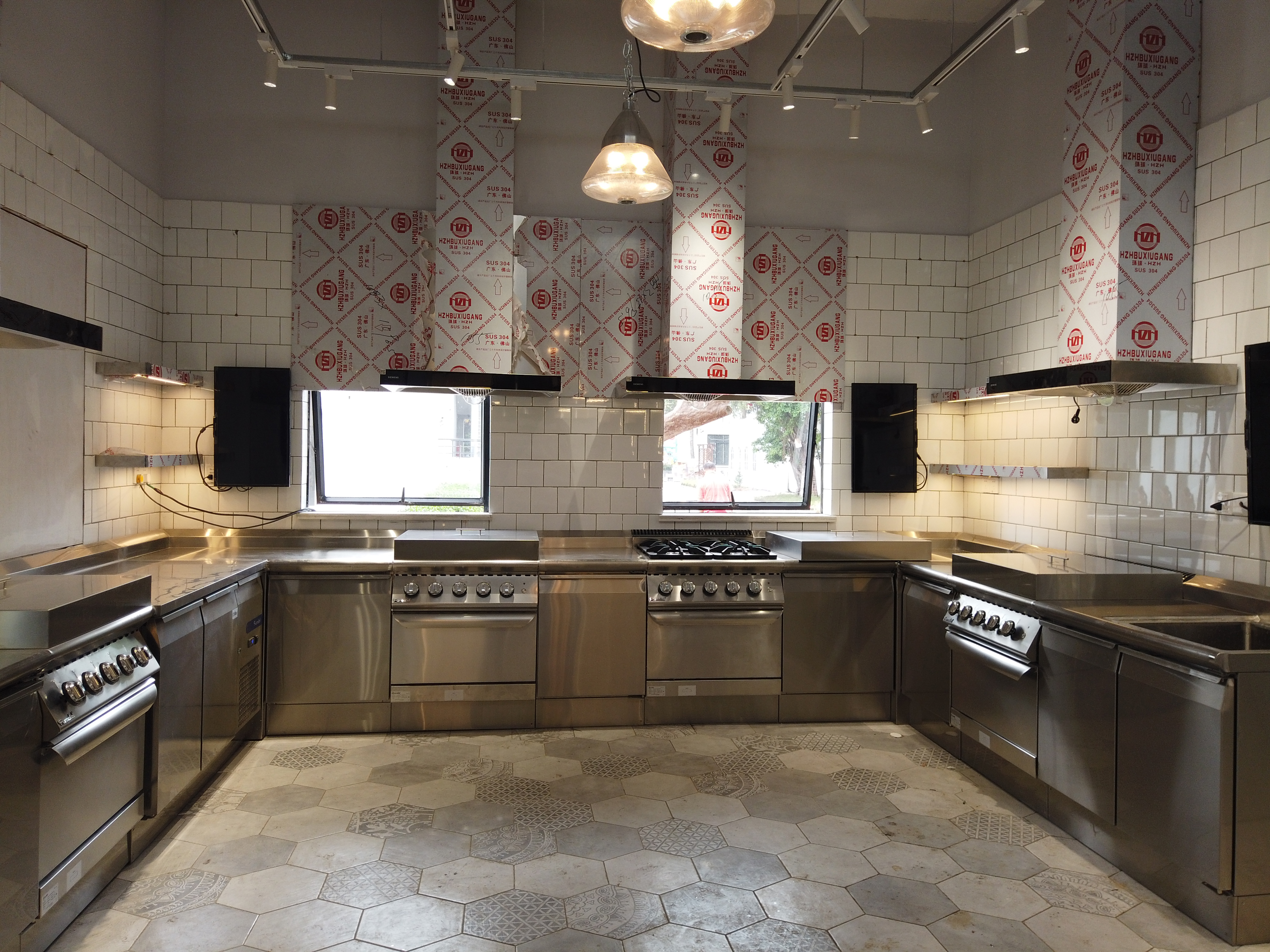
Overhead Rails, Suspended Shelving, and Fold-Down Work Surfaces for Flexibility
Overhead systems expand usable space without encroaching on valuable counter area. Install ceiling-mounted rails above prep stations to hang utensils, ladles, and measuring cups—freeing drawer space for bulkier tools. Suspended shelving above sinks or cooking lines stores spices, small wares, and dishware within arm’s reach. Fold-down work surfaces mounted to walls deploy as temporary prep space when needed and tuck away to open the floor plan. These flexible solutions let a small commercial kitchen adapt to high-volume cooking without requiring a larger footprint.
Choose and Configure a High-Throughput Galley Layout for Small Commercial Kitchen Layout
Galley vs. Other Layouts: Throughput, Staff Efficiency, and Scalability Data
A galley layout arranges workstations along two parallel walls with a central aisle, forming a straight-line workflow that minimizes wasted movement. According to foodservice engineering benchmarks, it reduces average staff travel distance by roughly 30% compared to L-shaped or U-shaped designs—directly boosting throughput. Kitchens using this configuration process 15–20% more orders per hour during peak shifts without adding staff. The narrow corridor enforces natural cross-traffic discipline, cutting collision risk by up to 40% versus open layouts. However, scalability is limited: adding more than two cooks will crowd the aisle. For a small commercial kitchen layout with a focused menu and three or fewer staff, the galley delivers the highest efficiency per square foot.
Optimal Dimensions: 48–60-Inch Aisle Width and Dual-Function Backsplash Integration
An aisle width of 48–60 inches is essential to prevent bottlenecks. Below 48 inches, staff cannot pass comfortably; above 60 inches, the kitchen wastes valuable linear space. Within this range, two people can work back-to-back without interruption. A dual-function backsplash—magnetic knife strips on one wall and a fold-down shelf on the opposite—turns dead wall space into active prep or landing areas. This approach reclaims up to 8 square feet of counter area, vital in a tight layout. It also integrates utensil rails and spice racks, keeping tools within arm’s reach and reducing unnecessary steps during service.
Select Multifunctional and Modular Equipment to Reduce Footprint Without Sacrificing Capacity
Top Space-Saving Appliances: Combi Ovens, Undercounter Dishers, and Convertible Prep Tables
In a small commercial kitchen layout, every square inch counts. Choosing versatile appliances that perform multiple roles eliminates the need for separate machines. Combi ovens combine convection, steam, and grill functions in one unit—replacing three standalone devices—while fitting into standard 36-inch-wide slots. Undercounter dishwashers and dishers slide directly beneath prep counters, using previously wasted vertical space. Convertible prep tables offer a two-in-one solution: a stainless steel work surface on top with refrigerated drawers or shelves below—reducing the footprint of separate refrigeration and table units. Modular shelving systems let you rearrange components as menu needs shift. Prioritize equipment with interchangeable parts or stackable configurations to allow future scalability. By selecting these space-conscious tools, you maximize capacity without expanding the kitchen’s physical boundaries.
FAQs
What is the 3-Zone Workflow Framework?
The 3-Zone Workflow Framework separates a small commercial kitchen layout into preparation, cooking, and serving zones, reducing cross-traffic and bottlenecks for optimal efficiency.
How wide should work aisles be in a small commercial kitchen?
Work aisles should be at least 48 inches wide for two-person traffic, ensuring comfort and safety.
What are some space-saving equipment options for a small kitchen?
Space-saving options include combi ovens, undercounter dishers, and convertible prep tables with refrigeration drawers.
How can vertical space be optimized in a small kitchen?
Use tiered storage zones, overhead rails, suspended shelving, and fold-down work surfaces to expand usable space.
What are the benefits of a galley layout?
Galley layouts minimize wasted movement, boost throughput, enforce cross-traffic discipline, and increase order capacity during peak shifts.