After-Sales:
 EN
EN
 AR
AR
 HR
HR
 NL
NL
 FI
FI
 FR
FR
 DE
DE
 EL
EL
 HI
HI
 IT
IT
 PT
PT
 RO
RO
 RU
RU
 ES
ES
 TL
TL
 ID
ID
 SL
SL
 VI
VI
 ET
ET
 MT
MT
 TH
TH
 FA
FA
 AF
AF
 MS
MS
 IS
IS
 MK
MK
 HY
HY
 AZ
AZ
 KA
KA
 UR
UR
 BN
BN
 BS
BS
 KM
KM
 LO
LO
 LA
LA
 MN
MN
 NE
NE
 MY
MY
 UZ
UZ
 KU
KU


News
How to design a cafeteria kitchen for a school?
Cafeteria Kitchen Design: Aligning Layout with School-Specific Workflow
Why Restaurant-Style Layouts Fail in K–12 Settings
Restaurant kitchen layouts prioritize speed for à la carte orders—but school cafeteria kitchen design must serve hundreds of identical meals in tight time windows. In commercial kitchens, cooks plate one dish at a time; in K–12 settings, staff batch-cook and hold food for multiple serving lines. The traditional “assembly line” approach creates bottlenecks when moving large carts and sheet pans across congested floors. It also overlooks critical school-specific needs: dedicated allergen prep zones, USDA-mandated temperature control stations, and space for bulk ingredient storage and tray assembly. Without these, staff waste time navigating narrow aisles and reworking inefficient workflows.
A school-specific plan eliminates friction by grouping tasks that share equipment and enabling simultaneous work without collisions. This intentional layout yields a 20–30% gain in meals produced per labor hour—far exceeding what’s possible when retrofitting a restaurant-style design into a school kitchen.
Four Core Functional Zones: Prep, Cook, Serve, and Clean — Purpose & Proximity Rules
A well-designed cafeteria kitchen divides the floor into four purpose-built zones, each positioned to support natural workflow progression and minimize cross-traffic.
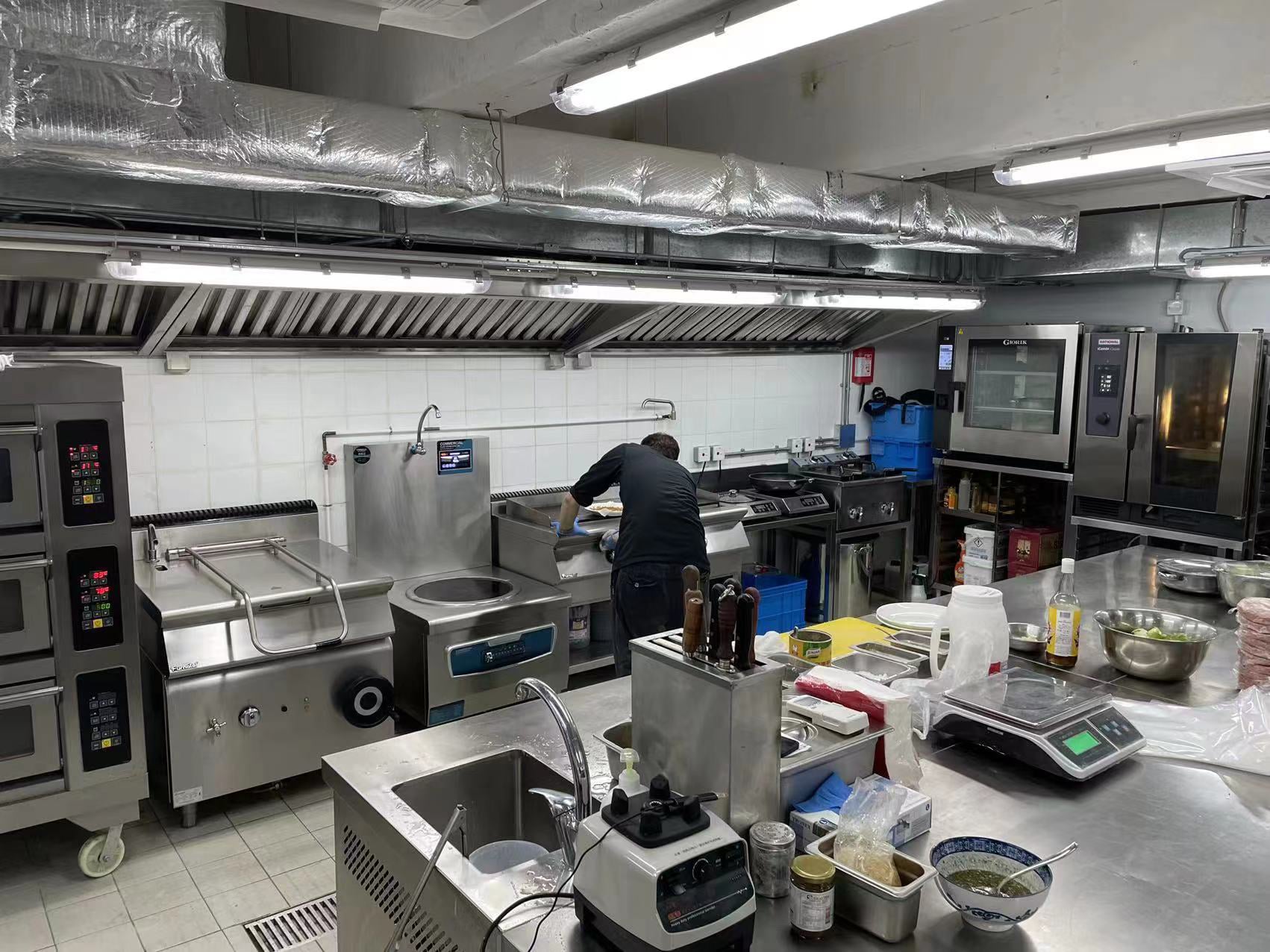
The prep zone, located adjacent to dry storage and the walk-in cooler, houses sinks, cutting tables, and vegetable processors—ensuring ingredients move directly from storage to preparation with minimal handling. From there, prepped items flow seamlessly into the cook zone, which clusters high-output appliances like combi ovens, steamers, tilt skillets, and stoves. Grouping these units allows one operator to monitor multiple cooking cycles—a necessity for efficient batch production.
The serve zone sits immediately beyond the cook line and includes heated wells, salad bars, and tray slides. It’s designed for dual access: staff loading trays and students moving through the line—without crossing paths used for raw food transport. Finally, the clean zone, housing dishwashers, pot sinks, and waste compactors, is placed at the exit of the serving area. This location supports a logical “dirty-to-clean” flow while isolating soiled items from food prep areas.
Proximity rules are non-negotiable: prep must adjoin storage and cooking; cooking must adjoin serving; and cleaning must be physically separated from prep to prevent cross-contamination. Adhering to these principles reduces staff steps by up to 40%, streamlines health code compliance, and sustains operational speed.
Safety, Hygiene, and Accessibility Compliance in School Cafeteria Kitchen Design
USDA/FDA Food Code & NFPA 96 Ventilation Requirements for K–12
School kitchens must comply with the USDA/FDA Food Code, which mandates impervious, nonporous, and corrosion-resistant surfaces in all food-contact zones. These materials prevent bacterial harborage in seams and crevices while resisting degradation from frequent chemical sanitation—critical for daily use in high-turnover environments.
Simultaneously, NFPA 96 requires commercial-grade hood systems capable of handling 1,500+ CFM airflow to manage grease-laden vapors generated during high-volume cooking. For K–12 facilities, this standard must be balanced with Child and Adult Care Food Program (CACFP) requirements for physical separation between food prep and waste disposal areas—minimizing cross-contamination risk without sacrificing throughput.
Integrating ADA Clearances and OSHA Egress Without Compromising Efficiency
Effective cafeteria kitchen design embeds accessibility and safety into its core geometry—not as afterthoughts. This means incorporating 60-inch wheelchair turning radii and maintaining 42-inch-wide walkways between workstations—exceeding ADA’s 36-inch minimum. Adjustable-height countertops (30–34 inches) provide inclusive prep surfaces without reducing usable workspace.
OSHA egress standards require unobstructed exit paths at least 28 inches wide. U-shaped workstation configurations achieve this while eliminating dead-end corridors—preserving 55–65% floor space utilization efficiency. Ergonomic studies confirm that compliant layouts support 27% faster service times, proving that regulatory adherence and operational excellence reinforce one another.
Equipment Selection and Capacity Planning for Optimal Cafeteria Kitchen Design
Right-Sizing Appliances to Daily Meal Volume (e.g., 1,200 vs. 3,500 Meals)
Accurate equipment sizing is foundational to cafeteria kitchen performance. Schools serving 1,200 meals operate under different constraints than those preparing 3,500+ meals daily. Under-sizing causes peak-hour bottlenecks; over-sizing wastes capital, energy, and valuable floor space.
Key capacity factors include:
- Peak-hour meal output requirements
- Batch processing capabilities (single-cycle vs. staggered cooking)
- NSF-certified equipment dimensions relative to available footprint
For instance, a four-unit steamer may handle 1,200 meals in one cycle—whereas halving capacity would force staggered batches, adding 30+ minutes to service time. Always base calculations on actual student enrollment—not theoretical seat counts or restaurant-style assumptions.
Energy-Efficient, Durable Equipment Built for Student Staff and High-Volume Service
Prioritize equipment that balances NSF certification, ENERGY STAR® qualification, and industrial durability. Stainless steel construction with rounded corners simplifies sanitation, while intuitive controls accommodate teenage kitchen trainees and part-time staff. Automated safety features—like auto-shutoff fryers and thermal cut-offs on steamers—reduce risk without slowing output.
Ventilation systems must meet NFPA 96 standards, and appliances should feature sealed burners, double-wall insulation, and tool-free access points for routine maintenance. Such specifications support 500+ daily cycles while lowering annual energy costs by 15–30%. When selected with both volume and people in mind, equipment becomes a strategic asset—not just a utility.
Frequently Asked Questions
Why are restaurant-style kitchens unsuitable for K–12 cafeterias?
Restaurant-style kitchens are designed for à la carte service, focusing on speed for individual dishes. School cafeterias require batch cooking, food holding, and service for large groups, making restaurant layouts inefficient.
What are the key functional zones for a cafeteria kitchen?
There are four key zones: prep, cook, serve, and clean. Each zone is strategically positioned to ensure smooth workflow progression and minimize cross-contamination risks.
How does compliance with ADA and OSHA standards affect kitchen efficiency?
Compliance promotes accessibility and safety without compromising operational speed. Wider walkways and ergonomic designs streamline tasks and reduce bottlenecks.
What factors influence equipment selection for school cafeterias?
Key factors include daily meal volume, peak-hour requirements, batch processing capabilities, and the physical dimensions of available kitchen space.
Why is energy efficiency important in kitchen design?
Energy-efficient equipment reduces operational costs while handling high-volume use, ensuring durability and sustainability in busy school kitchen environments.