After-Sales:
 EN
EN
 AR
AR
 HR
HR
 NL
NL
 FI
FI
 FR
FR
 DE
DE
 EL
EL
 HI
HI
 IT
IT
 PT
PT
 RO
RO
 RU
RU
 ES
ES
 TL
TL
 ID
ID
 SL
SL
 VI
VI
 ET
ET
 MT
MT
 TH
TH
 FA
FA
 AF
AF
 MS
MS
 IS
IS
 MK
MK
 HY
HY
 AZ
AZ
 KA
KA
 UR
UR
 BN
BN
 BS
BS
 KM
KM
 LO
LO
 LA
LA
 MN
MN
 NE
NE
 MY
MY
 UZ
UZ
 KU
KU

News
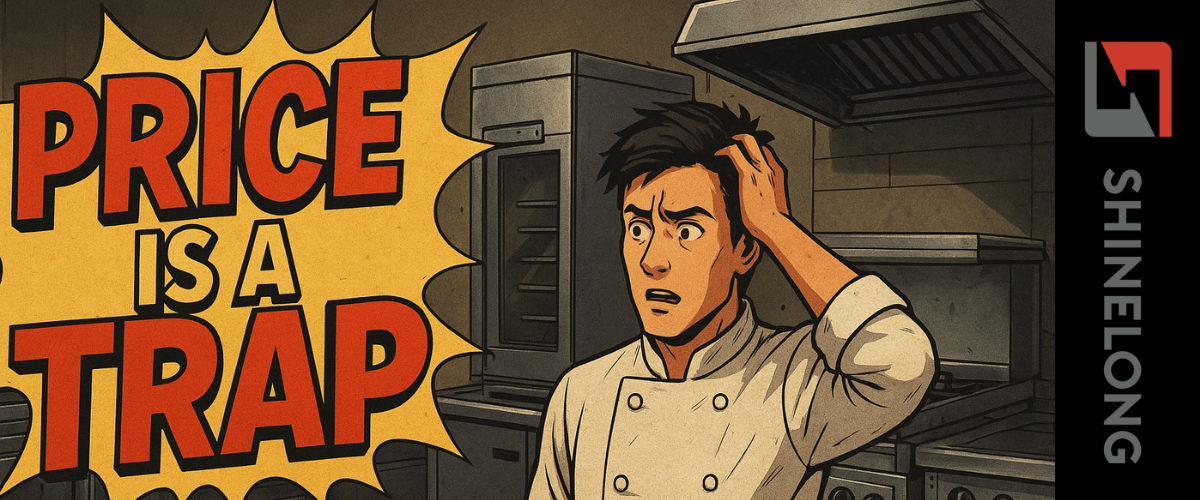
Price is Trap?8 Factors to Evaluate Before Investing in Commercial Kitchen Equipment
There's no doubt that selecting the right commercial kitchen equipment, especially heavy-duty or industrial models, is the most important part of building a professional kitchen. When dealing with a list of essential units equipped for commercial use, the initial capital outlay can be impressive, which is why most operators tend to choose the lowest quote. That seems like a wise option, right? Buying the cheap unit promises to help save your money right now.
However, this option is often a big mistake! That sounds counterintuitive, but in commercial foodservice, what looks cheap today can become costly tomorrow. A bargain brand seems to save money, but the real costs of high energy consumption, complex repairs, and operational downtime can quickly turn that initial "savings" into a severe long-term burden.
In this essential guide, we share eight significant factors every buyer must consider before closing a deal. Ignoring them is exactly how operators fall into the notorious price trap.
Why Cheap Price Costs More When Choosing Commercial Kitchen Equipment?
On the surface, a low-cost commercial appliance seems like a wise investment. However, this initial saving ignores the fact that a commercial kitchen operates under full shifts and rigorous demands, which means the bargain often leads to constant repairs, energy overconsumption, and premature replacement.
- Under-spec componentry. Cheaper units may use thinner stainless steel, lower-grade heating elements, or less-efficient compressors. That lowers their longevity.
- More frequent breakdowns. Repairs for these cheaper units often occur more often, and unplanned downtime can be expensive: in manufacturing contexts, an hour of unplanned downtime can cost hundreds of thousands of dollars.
- Shorter lifespan. Instead of lasting a decade, which is the industry average for foodservice catering equipment, budget equipment may require replacement in just four or five years. This effectively doubles your capital investment cost within that short timeframe.
- Hidden operating costs. Even with a low sticker price, inefficient appliances drive up electricity or gas bills, and that can easily outweigh initial savings over the life of the machine.
In fact, according to an equipment cost analysis, many businesses underestimate the Total Cost of Ownership (TCO) because they only focus on the purchase price.

Does the Brand’s Engineering Really Matter?
Absolutely, the manufacturing standard makes all the difference. A catering equipment supplier focused on high-quality products isn't merely "premium priced"; it is defined by superior materials, cutting-edge technology, and expert craftsmanship. Ultimately, this investment translates directly into unmatched performance, reliability, and reputation.
Take, for example, commercial cooking equipment like stoves and electric ranges. Premium units, such as our SHINELONG 700/900 series, meet the high demands for precise temperature control and stability by maintaining consistent heat, which is a factor crucial for food quality and portion consistency. This quality extends to the Durable Build, featuring high-grade steel like 304, stronger welds, and robust frames designed to resist deformation and wear under constant, heavy-duty use. Furthermore, thoughtful internal design ensures Efficient Airflow, facilitating even heat distribution and significantly reducing thermal stress on key components. Reliable manufacturing also includes Advanced Safety Features, such as crucial safety interlocks, superior insulation, and precise control systems.
Ultimately, strong engineering saves you not only on expensive repair and replacement costs, but also ensures production consistency. This commitment to quality translates directly into tangible operational benefits: less waste, fewer rejects, and significantly better guest satisfaction. At SHINELONG, our dedicated R&D department and engineers ensure that all equipment we manufacture and supply meets stringent international certifications.
How to Evaluate Build Quality Without Being a Technician?
You don’t need a mechanical engineering degree to assess whether a piece of equipment is built right. Here are practical checks when you go to purchase the equipment.:
- Weight and feel. Heavier units usually mean more robust materials. Pick up parts like doors or panels, and note how solid they feel.
- Door operation. A well-built door will close smoothly, with a firm seal. Weak hinges or poor alignment often point to cheaper designs.
- Inspect welds. Look for clean, continuous welds inside; messy or inconsistent welds often hint at shortcuts.
- Component quality. Check knobs, handles, trays, and racks — are they sturdy or cheap plastic?
- Ask for a demo. See the equipment running. Does it hum evenly? Do parts vibrate or feel flimsy?
These simple observations help you differentiate serious industrial-grade machines from cheaper, short-life alternatives.
What Should a Reliable After-Sales System Look Like?
After-sales service is, without question, more important than the initial price tag. A brilliant machine without adequate support is akin to a high-performance sports car with no warranty, incredibly valuable but prohibitively risky.
A good catering equipment supplier provides a comprehensive service that begins with rapid installation and setup, offering a turnkey solution from delivery, on-site installation and essential staff training. Crucially, their operational system must include wear parts and spare inventory, ensuring stocked spare parts and necessary consumables are readily available so that you are not waiting months for critical components. Furthermore, modern suppliers offer Remote and field support, utilizing remote diagnostics or phone assistance to identify potential problems before they escalate into full breakdowns. The best commitment extends to Regular follow-ups, where suppliers proactively check in with customers periodically to help catch minor issues early and ensure peak machine performance.
For example, SHINELONG’s after-sales system is built for long-term partnerships. Our 24/7 after-sales department ensures that serious customers receive immediate technical coverage and spare parts support exactly when it matters most. By routinely following up on each installation and collecting user feedback, they can proactively offer maintenance advice, solidifying their commitment to your sustained success.
How Fast Can the Supplier Repair or Replace Parts?
Instead of focusing on demanding local coverage, we pivot to demanding International Response Standards and Technical Preparedness. In process-intensive industries, maintenance programs that reduce downtime significantly can slash costs by up to 80%.
Here’s what to demand from your supplier:
- Defined SLA (Service-Level Agreement). Demand a clear Service-Level Agreement detailing the expected technical response time for a breakdown. For critical appliances, a commitment to dispatching technical support or spare parts within a guaranteed turnaround window is essential.
- Global Technical Coverage (Expert Dispatch). While local service coverage may be unavailable, ensure your supplier has a policy for dispatching expert technicians to your region. Be aware that the cost of travel and labor for this on-site support is typically the client’s responsibility, but the supplier must have the system in place to execute it swiftly.
- Guaranteed Spare Parts Supply Chain. The supplier must confirm sufficient global inventory of common replacement parts. While parts will be shipped internationally, demand clarity on the lead time and logistics support to minimize delays in customs clearance and delivery..
- Preventive maintenance options. Suppliers offering regular checkups help reduce emergency repairs.
Downtime would cause repair costs, lost revenue, wasted ingredients, and unhappy guests, which is unestimated. A fast, effective support system protects your investment.
Are You Checking Energy Consumption and Utility Load?
Energy costs are often the largest expense over a machine’s lifetime. According to the Carbon Trust, approximately 85% of the total lifetime cost of cooking equipment comes from energy usage.
Here are critical metrics to evaluate:
- Operating power draw. Confirm wattage / BTU ratings. Higher-efficiency models may be more expensive but save dramatically on utility bills.
- Load compatibility. Make sure your kitchen’s electrical infrastructure (voltage, wiring, breakers) matches the equipment’s demands.
- Ventilation requirements. Inefficient equipment may force your HVAC or hood system to overwork, adding hidden costs.
- Energy recovery or standby modes. Modern units may offer eco modes or sleep functions, valuable in kitchens that have slow hours.
Data shows that cooking devices can account for up to 35% of a restaurant’s energy usage, underscoring how inefficient machines quietly erode profitability.
How Suitable Is the Equipment for Your Menu and Volume?
Just because a piece of equipment is “commercial grade” doesn’t mean it's the right match for your business type. The best investment is one that fits your daily output, menu type, cooking technique, and growth plans.
Here’s what to assess:
- Daily throughput. Estimate volume at peak and off-peak times. Over-sized ovens are expensive; undersized units create bottlenecks.
- Menu complexity. A hotel kitchen with multiple cuisines needs flexible, multi-functional equipment. A pizzeria could do well with a specialized deck oven.
- Consistency needs. High-end restaurants require tools that maintain temperature and finish. Institutional kitchens such as company cafeterias or school kitchens prioritize capacity and ruggedness.
- Future expansion. If you plan to scale or franchise, choose modular or scalable commercial kitchen equipment that integrates into new layouts.
Choosing equipment that just meets your current demand, rather than overbuying, improves ROI and reduces wasted capital.
What About Cleaning and Daily Maintenance?
Cleaning and maintenance are the hygiene tasks. Here’s what to look for in design and support:
- Removable parts. Trays, racks, doors and filters should come off without tools, making daily cleaning easier.
- Rounded interior corners. This avoids food or grease accumulation and speeds up sanitation.
- Durable finish. Stainless steel should be high-grade, like 304 and welded cleanly.
- Filter and grease management. Good appliances channel grease to catchment areas that are easy to empty.
- Clear maintenance plan. Your supplier should provide cleaning schedules, spare part lists, and routine service guidance.
Neglecting maintenance leads to lower performance, higher energy use, and shorter equipment life. A well-designed machine with straightforward cleaning means fewer labor hours lost and less risk of unexpected breakdown.
Should You Consider Future Upgrades or Modular Design?
Thinking long term is how you decisively avoid the price trap. Even if today’s kitchen space is small, if your business plan includes aggressive growth, you need equipment that scales with your ambition. This requirement makes modular kitchen solutions the definitive option for addressing future uncertainty and maximizing ROI.
Modular units, such as stainless steel shelving and undercounter refrigeration, allow you to add capacity later without costly disruption or replacing the entire system. Furthermore, selecting a brand that supports component upgrades means you are significantly less likely to scrap entire machines prematurely.
Investing in smart commercial kitchen equipment is another crucial choice for controlling long-term costs. Features like IoT load tracking can monitor item performance, and programmable units can significantly reduce staff training and error costs. For multi-site operations, utilizing scalable equipment is the only way to maintain a consistent operational platform across all locations while rigidly controlling costs.
Conclusively, spending a bit more now to ensure flexibility and future readiness can easily save five times that amount down the road.
FAQ
Q1: Aren’t cheap appliances good enough if I plan to replace them in a few years?
A1: Only if you’re sure your replacement schedule won’t disrupt operations or cash flow. But cheaper units often fail faster, and downtime, repair, and replacement costs can outweigh any upfront savings.
Q2: How much more does energy-efficient equipment actually save?
A2: According to The Carbon Trust, up to 85% of the total lifetime cost of cooking equipment comes from energy use. High-efficiency models can reduce these costs significantly, recouping higher purchase prices in just a few years.
Q3: What is a reasonable turnaround time for repairs?
A3: In a professional kitchen, you should aim for a supplier that commits to an SLA of 72 hours or less for critical parts. That minimizes revenue loss from downtime.
Q4: How much should I expect to spend on annual maintenance?
A4: Restaurant maintenance costs often range from 1.5% to 3% of gross revenue annually. That includes preventive checks, calibration, and minor repairs.
Q5: Should I pay extra for modular or upgradeable equipment?
A5: Yes, it’s often worth it. Modular design saves on future capital because you can expand capacity without full replacement.
Q6: Can I trust the energy ratings that suppliers provide?
A6: Look for ENERGY STAR-rated or equivalent certifications, and ask for real-world energy data. Energy consumption is often the largest variable cost over an appliance’s life.