After-Sales:
 EN
EN
 AR
AR
 HR
HR
 NL
NL
 FI
FI
 FR
FR
 DE
DE
 EL
EL
 HI
HI
 IT
IT
 PT
PT
 RO
RO
 RU
RU
 ES
ES
 TL
TL
 ID
ID
 SL
SL
 VI
VI
 ET
ET
 MT
MT
 TH
TH
 FA
FA
 AF
AF
 MS
MS
 IS
IS
 MK
MK
 HY
HY
 AZ
AZ
 KA
KA
 UR
UR
 BN
BN
 BS
BS
 KM
KM
 LO
LO
 LA
LA
 MN
MN
 NE
NE
 MY
MY
 UZ
UZ
 KU
KU


News
Meat Band Saw Buying Guide for Butcher Shops: Best TPI, Blade Speed & Horsepower
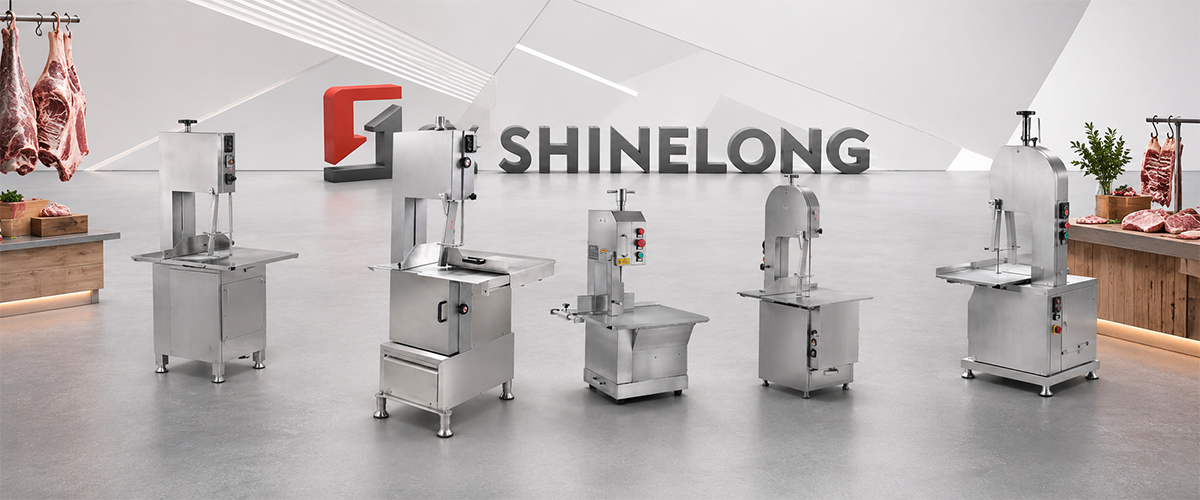
Choosing the right meat band saw comes down to three specs: blade TPI, blade speed, and motor horsepower. Get all three right, and the machine pays for itself — breaking down whole carcasses, portioning bone-in rib racks, splitting frozen blocks, and trimming fish, covers most of the exhausting meat processing tasks.
Isn't this versatile meat cutting equipment that all the butcher shops are looking for?
But knowing which model actually delivers it requires understanding what those three numbers mean in practice. This guide covers how TPI affects cutting performance, what horsepower is right for a commercial butcher saw, the tabletop vs. floor model decision, safety and maintenance basics, and a look at SHINELONG's butchering equipment lineup.
What Is a Meat Band Saw, and How Does It Differ from a Bone Saw?

A commercial meat band saw is a continuous-loop toothed blade stretched between two or three wheels, driven by an electric motor. The blade moves in one direction at a set speed while the operator feeds product against it. The result is a powered straight cut through material that would take minutes by hand.
-
Meat band saw vs bone saw: the terms are often used interchangeably, but sometimes they're not the same machine, even though their function is similar. A bone saw is designed primarily to cut through dense cortical bone and can include splitting types or reciprocating models. A meat band saw is the continuous-loop type, fitted with a small work table, and built to handle a much wider range of proteins: fresh muscle, fat trim, fish, and bone-in sections, all on the same machine — provided the blade and speed settings are adjusted for each task.
- Can the same saw handle fresh meat and bone-in cuts? Yes — but not with the same blade at the same speed. Fresh boneless muscle needs a high-tooth-count blade running fast. Dense bone needs fewer teeth and a lower speed. Operators who switch between both typically keep two blade types on hand and take two minutes to re-tension when the work changes.
TPI Explained, Choosing Between 3, 4, and 6 Teeth Per Inch
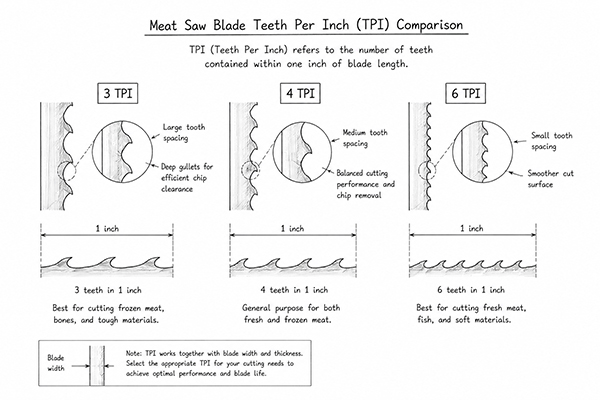
TPI in band saw for meat refers to Teeth Per Inch — pretty straightforward: the number of teeth along one inch of saw blade.
As one of the most significant features that determines cutting speed and performance, it's also the single most misunderstood spec on a meat saw blade. More teeth do not mean a better blade — it just means a blade suited to processing different portions. Each tooth removes a chip of material: fewer, larger teeth remove bigger chips per pass, ideal for dense or thick material; more, smaller teeth remove finer chips, ideal for thin, delicate cuts where surface finish matters.
That's why butchers prefer low-TPI blades such as 3 or 4 TPI when cutting frozen blocks or bone-in racks. And 6 TPI is generally the priority option for handling boneless meats or center cuts.
TPI Selection Table
| TPI | Best For | Not Ideal For | SHINELONG Model |
| 3 TPI | Large bone (beef femur, spine), dense frozen blocks | Thin fish fillets, small portions | 300A Bone Saw |
| 4 TPI | Everyday bone-in cuts (pork ribs, lamb rack, poultry), frozen fish | Very hard frozen blocks 15 cm | 210A Bone Saw |
| 6 TPI | Fish, thin boneless portions, fine decorative cuts | Dense bone or frozen product | 120A Bone Saw |
What blade size (length) is needed?
Blade length is determined by the saw's wheel spacing, not by the product being cut. Match the replacement blade length to the OEM specification for the specific SHINELONG model. Running an oversized or undersized blade will cause mis-tracking and premature wear.
Blade Speed: How Feet Per Minute (FPM) Changes the Cut
Blade speed is the velocity at which the blade loop moves past the meat or bone. It's measured in meters per minute (m/min) or feet per minute (FPM), and can be calculated using the wheel rotational speed (RPM) with the following formula: FPM=π× Wheel Diameter (in feet)×RPM
Blade speed and TPI work together: neither one alone determines cut quality.
Can a meat band saw cut frozen meat? Yes — but at the right speed. High blade speed on frozen product generates frictional heat that melts a micro-layer of ice around the blade, causing it to stick and pull. Slower speeds keep the contact zone cold, let the teeth shear the material cleanly, and protect the blade from thermal fatigue.
As a rule, the harder or colder the product, the slower the speed.
Blade Speed by Material
| Material | Recommended Speed | Why | Outcome |
| Frozen meat (block) | 50–80 m/min | Reduces friction heat; prevents blade warp and product smear | Clean face, no melt |
| Large bone-in (beef/pork) | 80–120 m/min | Enough force to pass through cortical bone without stalling | Smooth cut, minimal splinter |
| Fresh boneless muscle | 120–170 m/min | Fast throughput; soft tissue needs speed, not force | High-volume slicing |
| Fish/seafood | 150–200 m/min | Fine TPI at high speed produces a near-fillet finish | Retail-ready surface |
Variable-speed models give operators flexibility to dial in the right setting for each product type during the shift. Fixed-speed models are simpler to operate and maintain, but require the team to select the correct blade and speed tier at purchase time based on the primary product.
Motor Horsepower: Matching HP to Daily Volume
Horsepower determines how much resistance the motor can overcome before it stalls or trips a thermal overload. A saw with too little HP for the volume doesn't just cut slowly — it overheats, stalls mid-cut, and wears out the motor windings prematurely.
The right question isn’t “what is the maximum HP available?” but “what volume and product mix does this operation run every day?”
Motor HP by Operation Type
| HP Range | Operation Type Daily Volume | Daily Volume | Typical User | SHINELONG Model |
| 0.5–1 HP | Light duty | <50 kg/day | Deli counter, small specialty butcher | F125-1 Meat Band Saw (0.87HP) |
| 1.5–2 HP | Medium duty | 50–200 kg/day | Full-service butcher shop, steakhouse kitchen | F125-2 Meat Band Saw (1.5HP) |
| 3+ HP | Heavy duty | 200 kg/day | Wholesale processor, institutional kitchen, meat processing facility | K1921- 4 Meat Band Saw (3HP) |
A practical note on electrical supply: 3+ HP machines typically require a dedicated 3-phase circuit. Before purchasing a heavy-duty meat processing equipment, confirm that the site has the correct power infrastructure, or factor in an electrician's upgrade into the total cost of ownership.
Tabletop vs Floor Model: Which Type Fits the Operation?
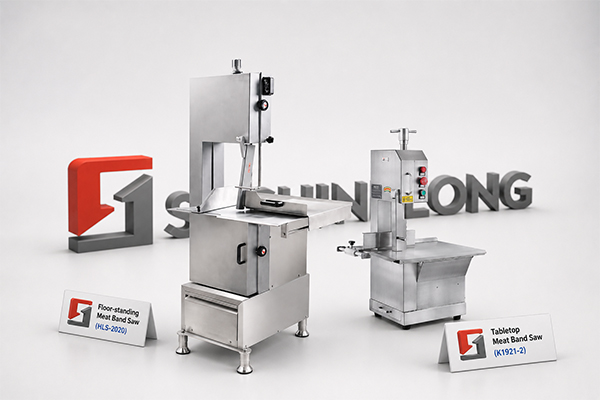
Format is not just about space — it determines the saw's usable throat (the maximum height of the product that can be fed through), HP ceiling, and long-term duty cycle. Neither type is universally better; the right choice depends on the specific operation.
Tabletop vs Floor Butchering Saw
| Factor | Tabletop Model | Floor Model |
| Motor power | Typically 0.5–1 HP | 1–3 HP |
| Daily throughput | Best for low–medium volume | Built for continuous heavy-duty use |
| Best for | Deli, specialty shop, restaurant kitchen | Wholesale butcher, processor, large institution |
If the operation cuts primarily full loins, large bone-in primals, or frozen blocks above 15 cm, go floor model. If the primary product is portions, retail-ready cuts, or fish, a tabletop handles the volume cleanly at a lower initial cost.
Safety, Maintenance & Blade Care
A meat band saw is productive only when it's safe and in calibration. The following covers the non-negotiables for any commercial butcher environment.
Safety Tips
- Cut-resistant gloves are mandatory for the feed hand
- Chain-mail apron or sleeve guards when processing large bone-in primals
- Non-slip footwear rated for wet environments
- Eye protection when cutting frozen blocks (bone chips and ice shards eject laterally)
- Blade guard in the raised position, adjust to just above product height, never remove
Cleaning and sanitation
Cross-contamination risk is real on any surface the blade touches. After every product change and at the end of each shift:
- Power off and lock out the machine before opening any guards
- Remove and rinse the blade tray, blade guide blocks, and feed table with warm water
- Scrub all surfaces with a food-safe degreaser; pay attention to blade tracking channels where fat accumulates
- Rinse and apply an approved food-contact sanitizer
- Allow to air dry or dry with clean single-use cloths before reassembling
Blade replacement and sharpening
-
When to replace:
A blade is ready for replacement when it takes noticeably more pressure to feed product, when cut surfaces show excessive tear-out or roughness, or when visual inspection reveals missing teeth, cracks, or corrosion. Under heavy use (100 kg/day), most commercial blades last 3–8 weeks before performance degrades below acceptable. -
Sharpening:
Band saw blades for meat processing can be sharpened, but this requires a dedicated blade-grinding machine and trained operators. For most butcher shops, the economics favor replacing a worn blade over maintaining in-house sharpening equipment. If the operation runs at a very high volume, SHINELONG would offer the proper solutions depending on the reality.
Tensioning
A blade that skips or wobbles is almost always a tension problem. Under-tensioned blades flex laterally and drift off line; over-tensioned blades stress the wheel bearings and crack prematurely. The correct tension varies by blade width and length — refer to the SHINELONG model's operator manual for the exact tension specification.
Best Brands for Butcher Shops
When it comes to meat-cutting equipment for butcher shops, there are plenty of options available — Hobart, BIRO, Sirman, and SHINELONG among them. The key differentiators to compare across brands are: total blade length compatibility, motor duty cycle rating (continuous vs intermittent), IP rating for the motor housing (important in wet environments), certifications, and local service coverage.
What makes SHINELONG stand out:
- Wide product range — tabletop and floor-standing models, 3 to 6 TPI meat saw blades, and industrial butchering saws up to 5 HP, covering light-duty deli counters through to high-volume processing operations.
- Global certifications — ETL, CE, LFGB, and RoHS certified, meeting international sanitary standards and cleared for operation across most markets, from Africa and Europe to South America.
- Durable build — stainless steel work table and feed surface ensure consistent, stable cutting across shifts. Saw blades are made of solid steel with smooth, hardened teeth capable of handling frozen meat, fish, and tough bone.
- Built-in safety features — a waterproof safety switch stops the machine automatically when any outer guard is opened. In an emergency, pressing the emergency stop button halts the unit within 0.2 seconds.
- After-sales support — replacement accessories, including saw blades, are readily available. All units come with a one-year warranty.
- Spec consultation — SHINELONG's team works closely with clients to understand the specific demands of their meat processing operation. The goal isn't just to supply a product, but to configure a functional processing line built around actual productivity requirements.
The Buying Decision
Three numbers determine the right commercial meat band saw: TPI for blade selection, blade speed for material compatibility, and horsepower for volume capacity. Get those three aligned with the operation's actual product mix, and the machine runs profitably for years.
The summary decision triangle: start with the primary product (what's being cut most often), choose the blade TPI and speed that match it, then size the HP to the daily throughput. Tabletop or floor format follows from space and volume. Everything else — brands, accessories, price — is secondary to getting those three core parameters right.
Ready to spec the right saw? Contact SHINELONG for a specification recommendation!
Read our blog to understand what Butchery Equipment is essential for Meat Markets: https://www.chinashinelong.com/essential-butchery-equipment-for-meat-markets--complete-guide
FAQs
-
How do I choose the right meat band saw for my butcher shop?
Choose based on daily volume. Medium shops need a 1.5-2 HP tabletop model, while heavy processors require 3+ HP floor models. Ensure blade speed and TPI match your core proteins.
-
Where can I buy high-quality meat band saws for sale?
You can buy certified commercial meat band saws from premium culinary equipment brands like SHINELONG. They provide worldwide after-sales solutions and custom processing specs.
-
What are the different types of meat saws used in butchering?
Primary types are tabletop models for delis or small kitchens and heavy-duty floor models for wholesale processors. They use varying blades like 3, 4, or 6 TPI for specific cuts.
- Can a meat band saw cut frozen meat?
Yes, but it requires a slow blade speed of 50–80 m/min. Lower speeds reduce friction heat, preventing ice from melting, which protects blades from warping. -
How do I choose the right blades for my meat bandsaw?
Match TPI to the product: use 3-4 TPI for dense bone-in racks or frozen blocks, and 6 TPI for boneless meats or delicate fish. Always follow the exact OEM length specification.