After-Sales:
 EN
EN
 AR
AR
 HR
HR
 NL
NL
 FI
FI
 FR
FR
 DE
DE
 EL
EL
 HI
HI
 IT
IT
 PT
PT
 RO
RO
 RU
RU
 ES
ES
 TL
TL
 ID
ID
 SL
SL
 VI
VI
 ET
ET
 MT
MT
 TH
TH
 FA
FA
 AF
AF
 MS
MS
 IS
IS
 MK
MK
 HY
HY
 AZ
AZ
 KA
KA
 UR
UR
 BN
BN
 BS
BS
 KM
KM
 LO
LO
 LA
LA
 MN
MN
 NE
NE
 MY
MY
 UZ
UZ
 KU
KU


News
A Guide to Transporting Food Safely in Institutional Foodservice
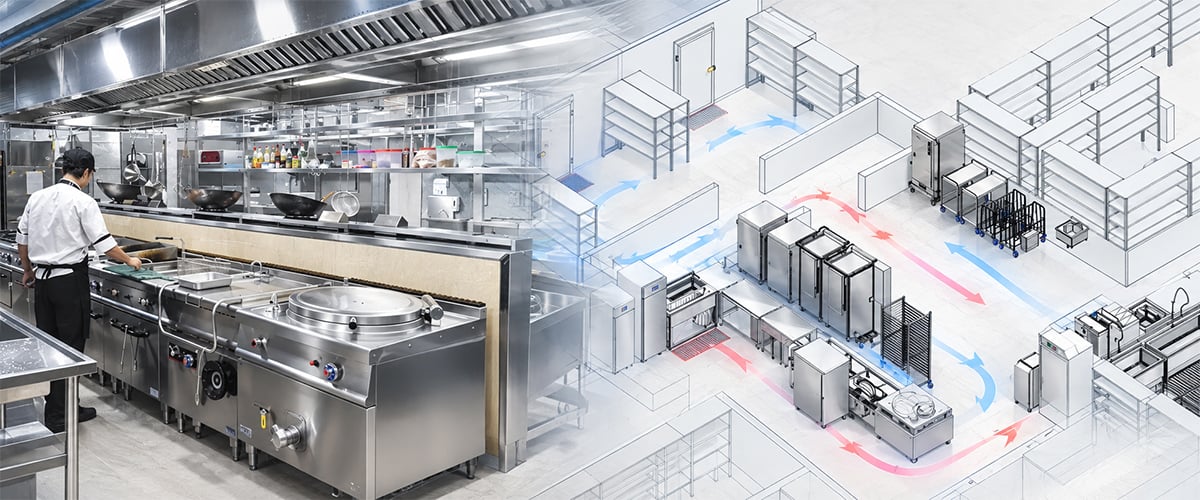
Safe food transport in institutional foodservice comes down to one thing: keeping meals within the right temperature range from the moment they leave the kitchen to the moment they're served.
Institutional facilities such as hospitals, universities, prisons and government facilities don't serve cooked food to guests immediately like restaurants do. They usually need to prepare a large quantity of meals in advance, then transport them to a specified area from communal halls, cafeterias, wards, or offices, sometimes minutes away, sometimes much further.
The real challenge is this: food spoils fast once it drifts out of that safe range, and a transport process without the right equipment or workflow puts every meal at risk. That's exactly why a reliable food transport solution is indispensable in institutional foodservice.
In this guide, SHINELONG kitchen experts walk you through how to transport food safely and efficiently in institutional foodservice, including essential food transport equipment, workflow design, and hygienic requirements. Let's jump right in.
Why Food Transport Matters in Institutional Kitchens
As a key part of institutional foodservice, food transportation plays an important role in the quality and freshness of meals being served, as well as food safety and the overall dining experience. That's because institutional cafeterias rarely serve meals directly to people, which is a main difference from the "cook-and-serve" production used by restaurants.
They primarily rely on a central kitchen to prepare cooked food, then transport it from the kitchen to the place where people actually eat, while keeping the food safe, hot (or cold), and presentable. In a hospital, that might mean a tray moving from the kitchen to a patient floor. In a university, it could mean transferring meals to the cafeteria serving line inside the communal dining hall.
Protecting Food Safety During Transport
Temperature control is the single biggest safety risk in food transport. The FDA Food Code defines the "danger zone" as 5°C to 57°C (41°F to 135°F), the range where bacteria multiply fastest, and other regions set similar limits under their own food safety codes. Every institutional food transport operation has to keep meals out of that band. In healthcare especially, the people eating these meals are often immunocompromised. A lukewarm chicken breast delivered to an oncology ward is not a service complaint. It is a clinical incident. That is why the temperature control involved in food transport is treated as a critical control point under HACCP. It is monitored, recorded, and audited.
Maintaining Meal Quality and Consistency
Safety is the floor. Quality is what patients, students, and residents actually notice. Soggy vegetables, cold gravy, and dried-out rice are the small failures that make institutional foodservice look sloppy. Well-designed food transport keeps texture, temperature, and appearance intact from the tray line to the fork.
Supporting Centralised and Multi-Site Operations
Modern institutional kitchens increasingly operate on a hub-and-spoke model. One central production kitchen cooks, chills, or holds food, and satellite sites, such as wards, classrooms, cafeterias and dining rooms, receive and serve it. Reliable food transport solution is the connective tissue. Without it, centralisation falls apart.
Temperature Control for Safe Food Transport
Holding meals at the right temperature range determines whether food transport succeeds or fails. The rules are pretty simple and straightforward, but they are non-negotiable, and a handful of universal standards make up the backbone of temperature control across institutional kitchens.
Hot Food Transport
Hot food must be held at or above 57°C (135°F) during transport. Heated holding cabinets, insulated hot boxes, and heated food trolleys are the tools that make this achievable. A catering hot box loaded straight out of the oven can hold a safe temperature for a good stretch of time, depending on insulation quality and how full the load is.
Pre-heating matters. Loading 60°C food into a cold cabinet is one of the most common ways hot food transport fails, because the cabinet steals heat from the food before the doors even close.
Cold Food Transport
Cold food must stay at or below 5°C (41°F). Refrigerated holding cabinets, insulated food carriers with gel packs, and refrigerated meal delivery carts handle this. For Cook-Chill workflows, chilled meals travel at 0 to 3°C and get reheated at the destination.
Monitoring Temperatures and Records
A thermometer probe at loading and another at unloading is the minimum. Better operations use data loggers or IoT-enabled carts that record temperature throughout the trip. Records are typically kept for at least the shelf life of the product, and many hospitals hold onto them well beyond that minimum, in line with their own retained-sample protocols.
| Food State | Target Temperature | Regulatory Basis |
| Hot food transport temperature range | ≥ 57 °C (135 °F) | FDA Food Code |
| Cold holding during food transport | ≤ 5 °C (41 °F) | FDA Food Code |
| Reheating to safe serving temperature | 74 °C (165 °F) for 15 seconds | FDA Food Code |
| Cook-Chill blast chilling | 70 °C → 3 °C within 90 minutes | HACCP / Cook-Chill standard |
| Danger zone (avoid) | 5 – 57 °C (41 – 135 °F) | FDA Food Code |
Essential Food Transport Equipment for Institutional Kitchens
Selecting the appropriate food transport equipment is one of the most significant foundations for moving large volumes of prepared food while keeping it safe and fresh. Preventing bacterial growth and food spoilage depends heavily on the tools chosen for the job. Here are six pieces of essential food transport equipment used across institutional foodservice.
Heated Holding Cabinets
Offering an insulated chamber that holds cooked food at a safe serving temperature, this is exactly what a heated holding cabinet can do. Standard models take GN 1/1 pans on rack slides, hold temperatures between 30°C and 85°C, and often include humidity control so roasted meats do not dry out. Mobile versions on heavy-duty castors double as food transport cabinets, holding food, rolling to the destination, and serving straight from the unit. Solid doors and glass doors are both available, and the choice comes down to whether staff need to see inside without opening the cabinet.
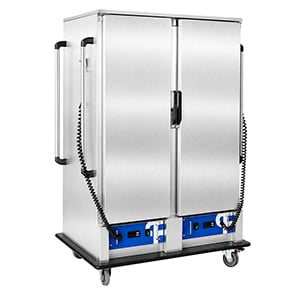
[Shop SHINELONG Heated Holding Cabinets]
Refrigerated Holding Cabinets
A refrigerated holding cabinet is the cold counterpart to the heated cabinet. Compressor-driven and built with a stainless steel 304 exterior and insulated interior, it provides a closed space for holding items at a stable temperature. Refrigerated cabinets are the go-to solution in cold food transport, handling salads, desserts, dairy, and chilled entrees waiting to be reheated on arrival.
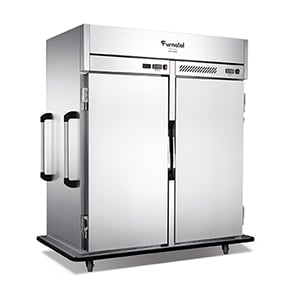
[Shop SHINELONG Refrigerated Holding Cabinets]
Bain Marie Trolleys
Combines a wet or dry well with wheels, and bain marie trolleys come in two main types: refrigerated trolleys and heated trolleys. It is the classic tray-service tool in hospitals and buffets, letting staff portion food straight from the trolley onto a patient's plate at the bedside. Modern units offer independently controlled wells, so soup, mains, and vegetables can each hold at their own ideal temperature.
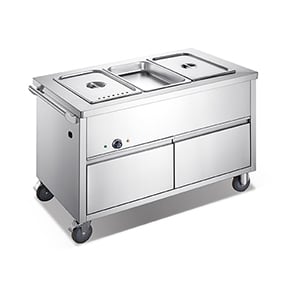
[Shop SHINELONG Bain Marie Trolleys]
Heated Meal Delivery Carts
A heated meal delivery cart is the enclosed cabinet that makes ward-round meal service work, typically holding 12 to 24 trays, sometimes split into a heated side and a refrigerated side for dual-compartment models. Staff plug the cart in at the hot end of the tray line, load it, unplug it, wheel it to the ward, and plug it in again at the ward galley. Done this way, the food never touches the danger zone during the trip.
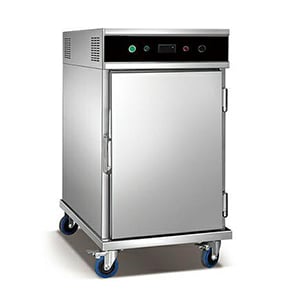
[Shop SHINELONG Meal Delivery Carts]
Insulated Food Carriers
An insulated food carrier is a passive system, with no plug and no compressor, relying instead on thick polyethylene walls and tight-sealing lids. It holds hot food above 57°C or cold food below 5°C for a limited window, depending on load size and ambient temperature. Insulated pan carriers accept full-size GN 1/1 or sheet pans, stack for transport, and are a go-to solution for off-site catering, school satellite kitchens, and emergency meal service.
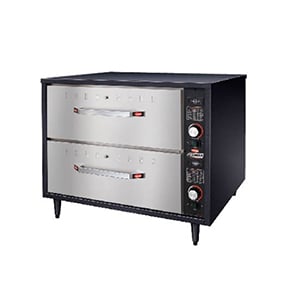
[Shop SHINELONG Insulated Food Carriers]
Food Transport Trolleys and GN Pan Carriers
This is the general-purpose category: stainless steel food transport trolleys with pan slides, gastronorm food carriers for bulk transfers, and tray-and-cutlery caddies. These do not always control temperature on their own. Instead, they move product between pieces of temperature-controlled equipment.
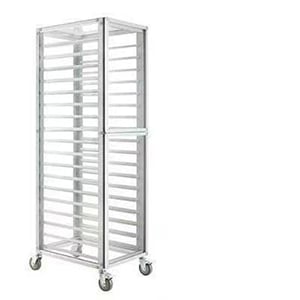
[Shop SHINELONG Food Trollery with GN Pan Carriers]
| Equipment Type | Best For |
| Heated holding cabinet (mobile) | Long tray lines, ward service |
| Refrigerated meal delivery cart | Chilled meals awaiting retherm |
| Bain-marie trolley | Bedside portioning |
| Insulated food carrier | Off-site catering, transported by trunk |
| Gastronorm food carrier | Bulk food transport between kitchens |
| Catering hot box | Events, mobile foodservice |
Design A Efficient Food Transport Workflow in Institutional Kitchens
Equipment alone does not make food transport safe. The workflow around it does.
Preparing and Holding Food Before Loading
Food goes into the transport cabinet at temperature, never on the way to temperature. Hot dishes are held at ≥63°C in the holding oven before loading, and chilled dishes come straight out of the blast chiller or walk-in at ≤5°C. The transport equipment itself should be pre-heated or pre-cooled, since a cold cabinet loaded with hot food is a food transport failure waiting to happen.
Packing and Loading Carts and Carriers
Load systematically, with the heaviest and hottest items on the bottom and lighter items on top. Avoid overfilling, since air circulation matters inside heated carts, and keep the doors closed as much as possible. Frequent door openings on a heated meal delivery cart let interior temperature slip, so staff should plan the loading sequence in advance rather than opening and closing repeatedly. Label every cart with contents, portion count, load time, and destination. Batch traceability during food transport is one of those small habits that pays off the day an inspector shows up.
Delivering, Serving and Recording at Destination
At the receiving end, probe-test one item per cart and record temperature, time, and the receiver's initials. If the temperature is out of range, do not serve. Recheck it, reheat to 74°C for 15 seconds if applicable, or discard the food. Institutional foodservice has no room for "close enough." For Cook-Chill sites, chilled meals arrive at ≤5°C and get reheated on the ward or in the satellite kitchen, using combi ovens, retherm cabinets, or microwaves to bring the food to a core temperature of 74°C for 15 seconds before service.
Cleaning and Maintenance Requirements
Every food transport cart, trolley, and carrier gets washed after every trip. A dedicated cart-wash bay with hot water spray, chemical detergent, and floor drainage is standard in hospital and central-kitchen designs. Gaskets and seals are inspected weekly, since a torn gasket turns an insulated food carrier into a leaky box, and heating elements and thermostats get calibrated on a regular schedule.
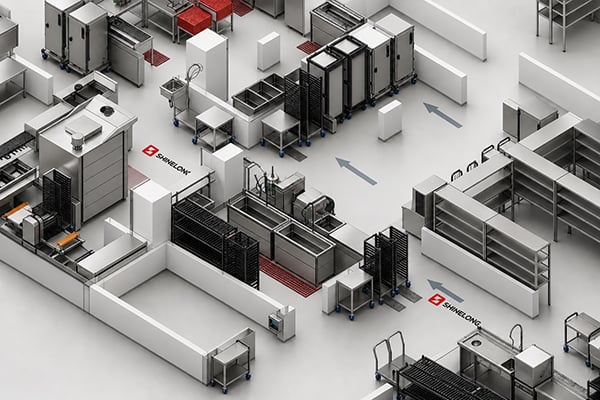
Food Transport Applications in Institutional Foodservice
Different settings put different pressure on food transport equipment.
1. Hospitals and Healthcare Facilities
Hospital food transport is the strictest use case, shaped by immunocompromised patients, treatment diets, IDDSI dysphagia-graded meals, and 24-hour operation. Centralised tray lines with heated meal delivery carts handle the bulk of meal service. Room Service models, where the patient orders like they would at a hotel, are growing fast, and they demand faster, more flexible food transport equipment to keep pace with on-demand ordering.
2. Schools and Universities
Central production kitchens cook for an entire district, while satellite school kitchens receive and serve the meals. Insulated pan carriers and heated food trolleys dominate this setting. Volumes are high and budgets are tight, so passive food transport containers with strong insulation get a lot of use, and speed matters just as much as temperature, since a K-12 lunch window is often only 20 minutes wide.
3. Care Homes and Senior Living
Bain-marie trolleys and dual-compartment carts are the tools of choice here. Portioning at the point of service, whether that's the resident's dining room or bedside, keeps meals looking fresh and gives dietary staff a chance to notice how much a resident is actually eating. Texture-modified diets add complexity, since pureed and minced-and-moist meals need equipment that holds moisture without turning food into soup.
4. Central Kitchens and Multi-Site Catering
Central kitchens and multi-site catering typically run on the Cook-Chill workflow: cook, blast-chill from 70°C to 3°C within roughly 90 minutes, store at 0 to 3°C, transport chilled in refrigerated food transport containers, then retherm at the satellite site. This model turns one central kitchen into the production hub for 20, 50, even 100 sites. The food transport equipment that makes it work includes refrigerated delivery cabinets, IoT temperature loggers, and cold-chain trucks with certified refrigeration.
Customize Your Food Transport Solution with SHINELONG
Food transport distance, the footprint of institutional kitchens, the number of people served, and the specific application all determine the final food transport solution. A 1,000-bed hospital has the strictest hygiene standards. A K-12 school pays more attention to nutrition management. A university communal hall prioritizes flexible dining times and diverse meal options.
With 18 years of experience in the commercial kitchen industry, SHINELONG has helped many institutional facilities set up functional commercial kitchens, including food transport sections that keep every meal's texture and quality intact from kitchen to plate. If a standard catalogue solution does not fit, our team can build a customized solution around your tray line, your ward layout, and your delivery route. Talk to a SHINELONG kitchen consultant, bring your floor plan, your meal volumes, and your service model, and walk away with a food transport solution that keeps every meal safe, hot or cold, from tray line to plate.
[View on SHINELONG Institutional Kitchen Cases]
Ready to design your food transport workflow? Contact SHINELONG for a free consultation and equipment proposal.
FAQs
1. What is food transport in institutional foodservice?
Food transport is the movement of prepared meals from a production kitchen to the point of service, such as a ward, classroom, dining room, or satellite site, while keeping temperature, hygiene, and quality within safety limits.
2. What temperature should hot food be kept at during transport?
At or above 57 °C (135 °F) per the FDA Food Code. Many operators target 63 °C to build in a safety margin.
3.What temperature should cold food be kept at during transport?
At or below 5 °C (41 °F). Chilled meals in Cook-Chill systems typically travel at 0–3 °C.
4. What equipment is used for food transport in hospitals, schools, and care homes?
Heated holding cabinets, refrigerated meal delivery carts, bain marie trolleys, insulated food carriers, gastronorm food carriers, and food transport trolleys.